A urinary tract infection (UTI) means bacteria are inside the urinary tract and the body has reacted to them. The reaction is the operative part: bacteria can sit in urine without inflammation or symptoms, and that state is not an infection. In a child, three problems stack on top of each other — a bacterial adhesion problem, an organ-defence problem, and an inflammatory problem that can leave the kidney permanently scarred. Holding those three layers together makes the diagnosis, the imaging decisions and the long-term renal risk fall out of the same mechanism.
What the terms mean
- Bacteriuria — bacteria present in urine without an inflammatory response.
- Cystitis — inflammation confined to the bladder, usually without fever.
- Febrile UTI — infection that has reached the renal parenchyma, with fever as its signature.
In pediatric practice a febrile UTI is treated as pyelonephritis, meaning infection of the renal parenchyma (the functioning tissue of the kidney) rather than bladder-limited disease. Imaging supports that framing: most febrile infants and young children with a UTI show acute renal parenchymal changes on scintigraphy, a nuclear scan of the kidney, although an acute lesion does not always become a permanent scar. An “afebrile UTI” therefore does not mean by definition that the kidney is uninvolved; it means the clinical syndrome is limited to the bladder.
Guidelines draw that boundary clinically rather than radiologically. Bacteriuria with a temperature of 38°C or higher, or bacteriuria with a temperature below 38°C together with loin pain or tenderness, is treated as acute upper UTI — pyelonephritis; bacteriuria without systemic symptoms or signs is lower UTI, or cystitis. The temperature is a threshold for action rather than a measure of how much kidney is involved.
The defences the urinary tract relies on
Whether bacteria that enter the urethra go on to cause an infection depends on how well the tract clears them. The inner lining of the tract, the uroepithelium, is where that contest is decided, and three defences matter, in descending order of importance:
- Unidirectional urine flow. The constant stream from kidney to bladder washes bacteria out. When flow slows — obstruction, stasis, incomplete emptying — bacteria have time to adhere to the lining.
- An intact uroepithelium. Bacteria cannot cross a continuous mucosal surface unless it is damaged.
- Acidic urine pH. This helps, but it is not the main barrier.
Behind those three sit additional mucosal defences. Uromodulin (Tamm-Horsfall protein), secreted by the cells of the thick ascending limb of the loop of Henle, binds type 1 fimbriae (the adhesive filaments described below) and traps bacteria in the lumen. Antimicrobial peptides are secreted into the urine. And the glycosaminoglycan layer that coats the surface cells of the bladder lining (the umbrella cells) resists bacterial binding. Even so, flow and an intact surface carry most of the weight, which is why the organism that causes most infections is the one best equipped to hold on against the flow.
Why Escherichia coli dominates
Escherichia coli causes about 70–80% of childhood UTIs in classic teaching; a recent tertiary-center series found 64%, with Klebsiella, Pseudomonas, Enterobacter, Proteus and Enterococcus making up most of the remainder. Viruses rarely cause primary UTI.
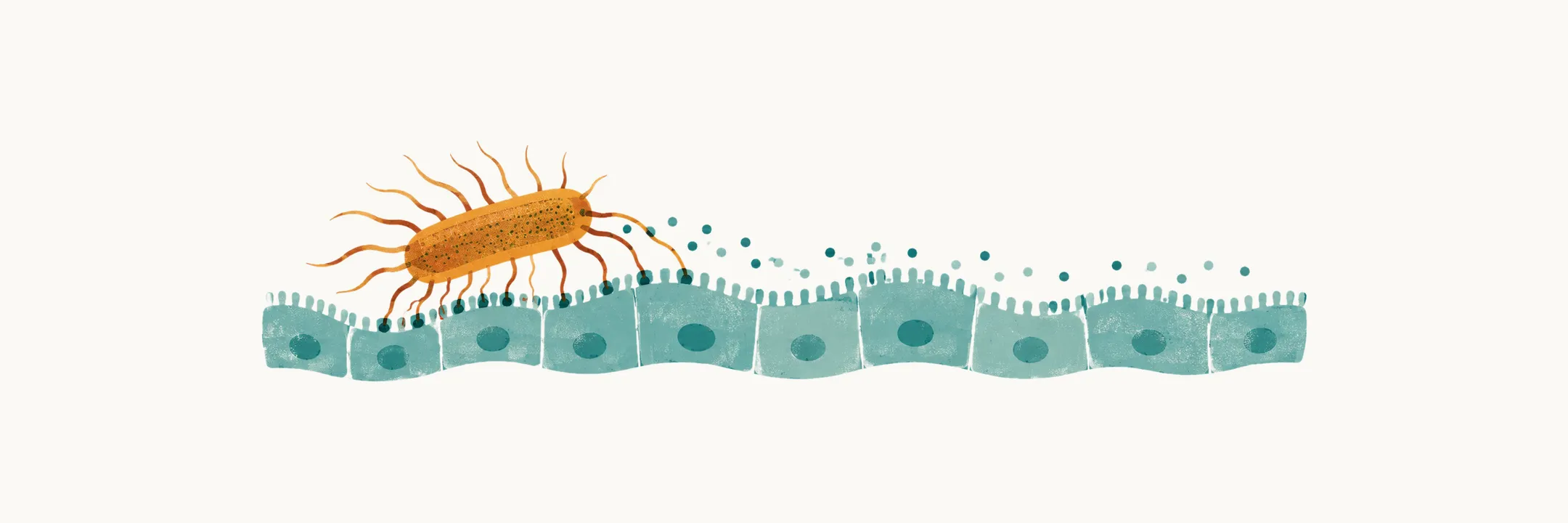
E. coli succeeds because it carries fimbriae (pili) — protein filaments that bind receptors on the uroepithelium and let the bacterium hold its position against the flow of urine. Type 1 fimbriae bind mannose-containing receptors, P fimbriae bind glycolipids on renal pelvic epithelium. Adhesion is what allows ascent from bladder to kidney; without it, the upper tract is difficult to reach.
Why a non-E. coli organism is a structural clue
Klebsiella, Pseudomonas, Proteus and Enterococcus do not share E. coli’s adhesin toolkit, so they climb the tract poorly on their own. When they appear in a young child’s urine, they more often arrived through a urinary tract that carries urine (and bacteria) upward. In a single-center series of 139 children hospitalised with a UTI, 14 of the 32 children (43.8%) infected by a non-E. coli organism had an underlying urinary tract malformation, versus 4 of the 107 infected by E. coli (p < 0.0001), and 14 of the 18 children with a malformation were infected by a non-E. coli organism. This association is the basis of the clinical rule: a febrile UTI in a young child caused by a non-E. coli organism raises the probability of an underlying structural abnormality and shifts the workup towards imaging, particularly cystography, an X-ray study that follows contrast in the bladder as the child voids.
From bacterial adhesion to fever
Adhesion explains how E. coli reaches the kidney; the illness itself comes from the host’s response once it arrives. Three sequential events produce it:
- Adhesion. Fimbriated E. coli reaches the renal pelvic uroepithelium and binds it. Without binding, the kidney is safe.
- Innate immune recognition. Lipopolysaccharide (LPS), a component of the outer wall of E. coli, engages the TLR4/CD14 complex on the uroepithelial cell surface — a receptor system (toll-like receptor 4 with its co-receptor CD14) that recognises this bacterial molecule. The intracellular cascade activates NF-κB, a transcription factor, which translocates to the nucleus.
- Cytokine transcription. NF-κB drives production of the cytokine interleukin-6 (IL-6), which acts on the hypothalamic set point and produces the fever, together with tumour necrosis factor alpha (TNFα) and interleukin-8 (IL-8), which increase local vascular permeability and recruit neutrophils — the cells responsible for pyuria (white cells in the urine) and for the inflammatory infiltrate of pyelonephritis.
The fever is therefore a cytokine event, not a direct effect of bacteria on the brain. That explains why the temperature can be high while urinary findings look modest.
At a glance
- Febrile UTI in a child means renal involvement until shown otherwise, and a temperature of 38°C or higher is the clinical boundary of upper tract disease.
- Defence hierarchy: urine flow → intact uroepithelium → acidic pH as an assistant, not the main barrier.
- The inflammatory chain: fimbrial adhesion → LPS–TLR4/CD14 → NF-κB → IL-6 (fever), TNFα and IL-8 (neutrophils).
- Fever is a cytokine event, which is why a child can be hot with only modest urinary findings.
- A non-E. coli febrile UTI in a young child points towards a structural abnormality, not just towards a different antibiotic.