
Vesicoureteral reflux (VUR) is the retrograde flow of urine from the bladder back up the ureter towards the kidney. It exists because the ureterovesical junction, where the ureter enters the bladder, fails to act as a one-way valve. Normally the last segment of ureter runs through the bladder wall in a submucosal tunnel, and as bladder pressure rises during voiding that segment is compressed against the wall, which seals it. When the submucosal tunnel is too short, when the junction is malpositioned, or when bladder pressure is chronically high, the seal fails and urine travels the wrong way.
Two mechanisms of harm follow. Refluxed bacteria reach the renal parenchyma and cause febrile urinary tract infection (UTI), and repeated episodes scar the kidney. But infection is not the only mechanism: sterile urine under sustained high bladder pressure can itself damage the developing kidney, which is why dysplasia — abnormally formed kidney tissue — is sometimes found in kidneys draining a high-pressure system before any infection has occurred.
Idiopathic or secondary
The most useful split is by cause, because it determines treatment.
| Type | What it means | Typical causes | Behaviour |
|---|---|---|---|
| Idiopathic (primary) | Developmental incompetence of the ureterovesical junction with no other urinary tract disease | Short or malpositioned submucosal tunnel | Lower grades; often resolves as the child and the tunnel grow |
| Secondary | Reflux caused by another abnormality that raises bladder pressure or disturbs the junction | Posterior urethral valves, neurogenic bladder (a bladder whose nerve supply is impaired), bladder and bowel dysfunction including overactive and dysfunctional voiding patterns, previous ureterovesical surgery | Higher grades, more scarring, and unlikely to resolve until the underlying problem is corrected |
Posterior urethral valves, congenital folds that obstruct the posterior urethra in boys, are the most aggressive secondary cause. The obstruction raises pressures upstream, drives urine backwards into kidneys that are often already dysplastic, and adds infection on top of pressure injury. Treating the reflux without relieving the valve obstruction does not work.
Grading
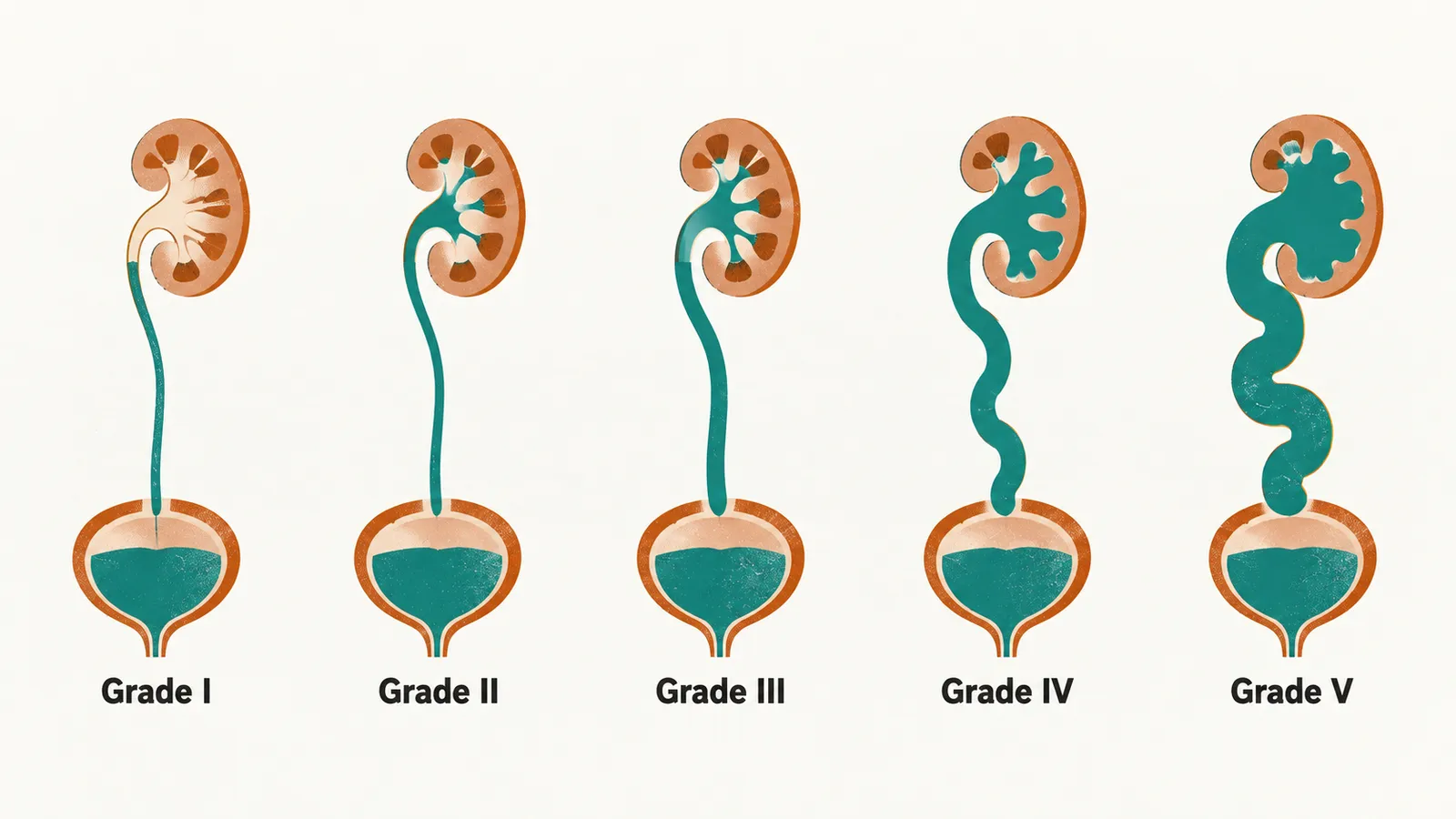
Reflux is graded on cystography — an X-ray study in which contrast fills the bladder and is watched as the child voids — using the International Reflux Study system. The system describes how far contrast travels and how much the collecting system dilates. The terms in the table refer to the drainage anatomy of the kidney: urine collects in the calyces, cup-shaped chambers into which the renal papillae project, and passes from them into the renal pelvis; the fornices are the sharp angles at the rim of each calyx.
| Grade | Cystographic appearance |
|---|---|
| I | Reflux into the ureter only; no dilatation |
| II | Reflux reaches the renal pelvis and calyces without dilatation |
| III | Ureter and pelvis dilated, with mild or no blunting of the calyces |
| IV | Greater dilatation with tortuosity; the sharp angle of the calyceal fornices is obliterated but papillary impressions remain visible |
| V | Gross dilatation and tortuosity; papillary impressions are frequently absent |
Grades I and II are usually described as mild, grade III as moderate, and grades IV and V as severe. The grade is not the whole decision, but it shifts the balance: lower grades are more likely to resolve spontaneously, and higher grades carry a higher risk of further scarring with each febrile infection.
Why reflux is treated at all
The purpose of treatment is not to correct an image, it is to prevent the next febrile UTI and the next scar. Two facts anchor that aim. Reflux raises the frequency of febrile UTI, and the number of febrile UTIs is what drives scarring: in one analysis of 345 children, scarring was present in 2.8% after a single febrile UTI, 25.7% after two, and 28.6% after three or more.
The three options
Three strategies serve that aim, and they differ in how much they intervene.
Surveillance. For low-grade reflux with no scarring and no recurrence, in a child with normal bladder and bowel function, observation is a reasonable choice: periodic review, education of the family, and prompt treatment of any breakthrough infection. Much grade I–II reflux resolves during childhood as the bladder and the submucosal tunnel grow, so an operation performed early would treat a problem that would have disappeared.
Antibiotic prophylaxis. A low daily dose of an agent such as trimethoprim–sulfamethoxazole or nitrofurantoin aims to keep the urine sterile during the years of greatest risk. The RIVUR trial is the key evidence: in 607 children aged 2–71 months with grade I–IV reflux after a first or second febrile or symptomatic UTI, two years of continuous trimethoprim–sulfamethoxazole reduced recurrent febrile or symptomatic UTI from 23.6% to 12.9% (hazard ratio 0.50, 95% confidence interval [CI] 0.34–0.74), but did not reduce new renal scarring (8.2% versus 8.4%). Resistance rose in the treatment group: 63% versus 19% of first recurrent E. coli isolates were trimethoprim–sulfamethoxazole resistant. Prophylaxis is therefore a reasonable option for reducing recurrence in selected higher-risk children, not a default for every child with reflux, and it carries a resistance cost.
Surgical correction. Surgery is considered for high-grade reflux, breakthrough febrile UTIs despite prophylaxis, progressive scarring, or secondary reflux with a correctable cause. The classic operation is ureteral reimplantation, which rebuilds a longer submucosal tunnel to restore the valve mechanism. Endoscopic injection of a bulking agent at the ureterovesical junction is a less invasive alternative for selected moderate grades, with a lower success rate per procedure. In secondary reflux the first step is to treat the cause: endoscopic ablation of posterior urethral valves, management of a neurogenic bladder, or treatment of bladder and bowel dysfunction.
What actually drives the decision
The question is not “surgery or no surgery” but “which child needs intervention to prevent the next febrile UTI and the next scar”. The factors that enter that judgement are the grade, the child’s age, whether scarring is already present, how often infections recur, and whether an underlying cause is treatable. A grade IV reflux caused by posterior urethral valves and a grade IV reflux in a child with an overactive bladder and constipation do not have the same solution even though the images look alike.
At a glance
- VUR is failure of the ureterovesical valve to prevent retrograde flow, and it can damage kidneys by pressure as well as by infection.
- Idiopathic reflux often resolves; secondary reflux usually needs the underlying cause fixed.
- Posterior urethral valves are the most damaging secondary cause.
- Grades I–II mild, III moderate, IV–V severe on the International Reflux Study scale.
- RIVUR: prophylaxis halved recurrent UTI but did not reduce scarring, and increased antibiotic resistance.
- Treatment is aimed at preventing febrile UTI and scarring, and depends on grade, age, scarring, recurrence and cause together.