
A urinary tract infection (UTI) — bacteria in the urinary tract together with a response from the body — looks like four different illnesses depending on the child’s age. The reason is developmental rather than bacteriological: a child below roughly 3 years cannot localise pain (show where it hurts), cannot describe dysuria (pain on passing urine), and cannot report urgency (a sudden need to void that is hard to defer). Once a child can talk about bladder sensation, the textbook symptoms appear. The age band therefore determines what to suspect, what to ask about, and how urgently to act.
Sex shifts the picture within each band. Girls carry a higher lifetime risk because their urethra is short, which shortens the distance periurethral and vaginal flora must travel to reach the bladder. Boys’ risk is concentrated in infancy, in part because the foreskin provides a colonisable mucosal surface for uropathogens; the highest recorded prevalence in any group is in uncircumcised boys under 3 months with fever.
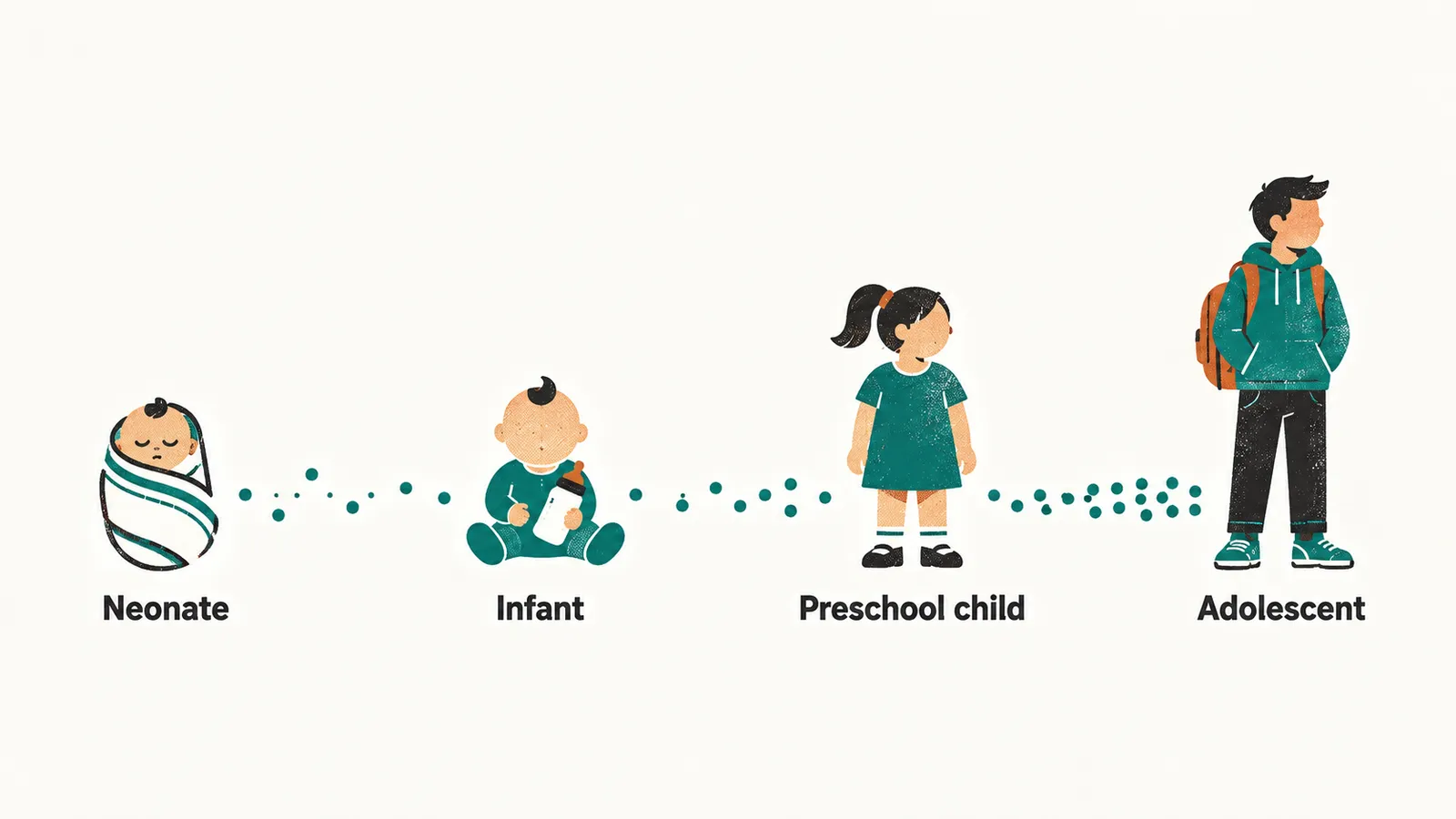
Neonate — first 28 days
Presentation is systemic and non-specific:
- Jaundice, including a conjugated hyperbilirubinaemia pattern (a raised conjugated, or direct, bilirubin)
- Fever or hypothermia
- Poor feeding
- Vomiting
- Failure to thrive (poor weight gain)
Temperature is often the only objective abnormality. Any neonate with fever and no clear focus needs blood and urine cultures with empiric antibiotics — started before the organism is known — rather than observation, because this age group can deteriorate quickly into urosepsis, sepsis arising from the urinary tract. The urine is usually obtained by urethral catheter or by suprapubic aspiration (a needle passed through the lower abdominal wall into the bladder), since waiting for a spontaneous void is not safe in an unwell neonate.
The probability of a UTI as the source of fever is highest in this group in uncircumcised boys, where the pooled prevalence in infants under 3 months is 20.1%.
Infant — 1 month to about 18 months
Symptoms remain non-localising:
- Fever
- Poor feeding
- Vomiting, diarrhoea
- Strong-smelling urine
The sequence of reasoning is to exclude other bacterial foci first — otitis media, tonsillitis, pneumonia, meningitis — and then to consider the urinary tract. Irritability and crying do not localise, and an infant with fever and no focus has a pooled probability of UTI of 7.0% (95% CI 5.5–8.4). That figure is what justifies screening a urine specimen in this band rather than in every febrile child at every age.
Preschool and school-age child — about 3 to 10 years
Once the child can speak about pain and bladder sensation, infection of the kidney and infection of the bladder separate into two recognisable syndromes:
- Febrile UTI / pyelonephritis, infection that has reached the kidney, presents with abdominal or flank pain, sometimes with vomiting. The child can localise the painful side, so this presentation is usually taken seriously and investigated.
- Cystitis, infection confined to the bladder, presents with the lower-tract triad of dysuria, urgency and frequency (voiding more often than usual), with secondary enuresis as an occasional soft sign rather than a diagnostic one. Cystitis is usually afebrile.
That soft sign depends on terms that are easy to misuse. Enuresis is the clinical term; bed-wetting is the patient-facing equivalent. Two distinctions matter. A child cannot be diagnosed with enuresis as a disorder before about 5 years, because night-time control is still developing: nocturnal continence is usually achieved around age 5, roughly 2 years after daytime control. And the split between primary enuresis (never dry) and secondary enuresis (dry for a period, then wet again) becomes diagnostically meaningful from about age 5 onwards, because secondary enuresis raises the possibility of bladder inflammation, bladder-bowel dysfunction or a UTI.
Adolescent — the adult pattern and a wider differential
Above roughly 10–12 years the symptom set is the one seen in adults: dysuria, frequency, urgency, suprapubic discomfort and sometimes visible haematuria (blood in the urine).
What changes at this age is the list of other explanations. In adolescent girls who present with dysuria, the differential is not confined to the urinary tract: vaginitis and sexually transmitted infections are common explanations, and in some series urinary symptoms in adolescent females are more often associated with a sexually transmitted infection than with a UTI. A cystitis label without examining the external genitalia in an adolescent girl is an incomplete assessment.
Common scenarios
Putting the age band together with the presenting picture gives a first line of reasoning for typical children:
| The child | What to consider first | Initial workup |
|---|---|---|
| Febrile 18-day-old, no focus | Urosepsis | Catheter or suprapubic urine + blood culture + empiric antibiotics |
| Febrile 12-month-old, uncircumcised, no focus | UTI (probability about 7%) | Urine specimen before antibiotics, by catheter if unwell |
| Febrile 4-year-old girl with abdominal pain | Pyelonephritis | Urine culture, empiric treatment, imaging per local protocol |
| 7-year-old with dysuria, frequency, secondary enuresis | Cystitis | Clean-catch culture, empiric treatment |
| 15-year-old girl with dysuria | Vaginitis or sexually transmitted infection as well as UTI | External genital examination and testing, not antibiotics alone |
What remains uncertain
The age bands and symptom patterns above are clinical reasoning aids, not a quantitative risk score: temperature thresholds and symptom combinations that shift pretest probability are not well defined in the literature. Because neither age nor symptoms can settle the question, the diagnosis rests on the urine itself, and on how that urine was collected.