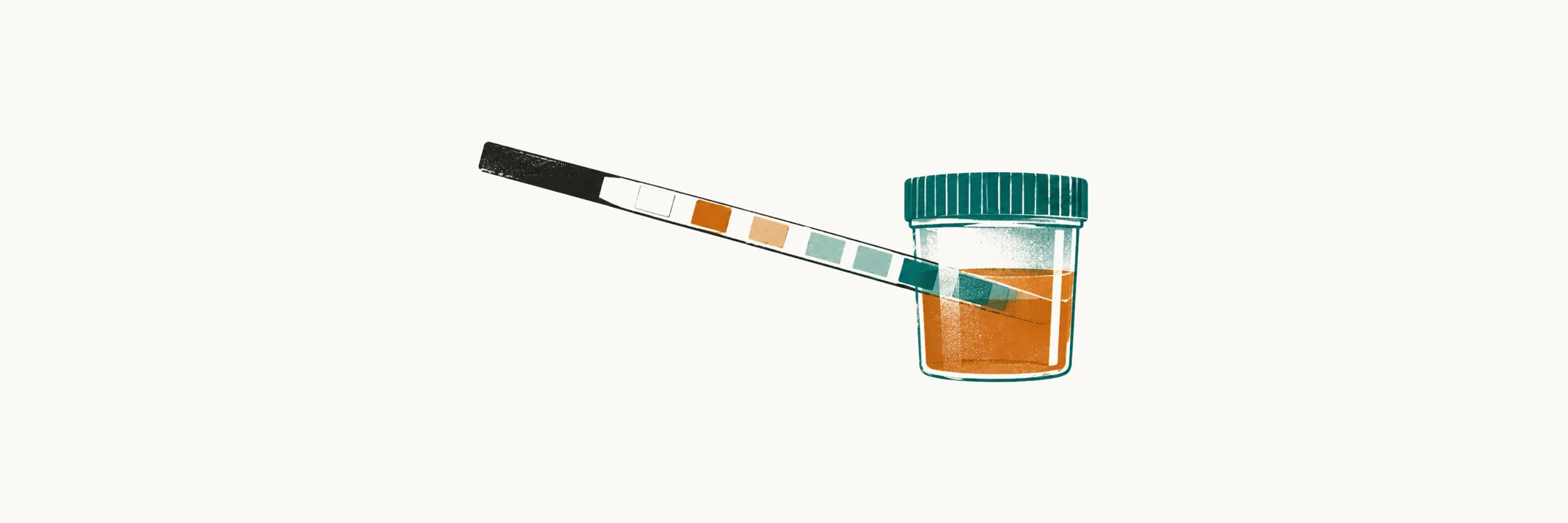
The difficult part of diagnosing a urinary tract infection (UTI) in a child is not deciding which antibiotic to use; it is obtaining a specimen that means something. Young children do not void on command, cannot aim, and cannot discard the first part of a stream. The solution most services use is a tiered sequence in which a non-sterile screening specimen decides whether a sterile specimen is needed at all.
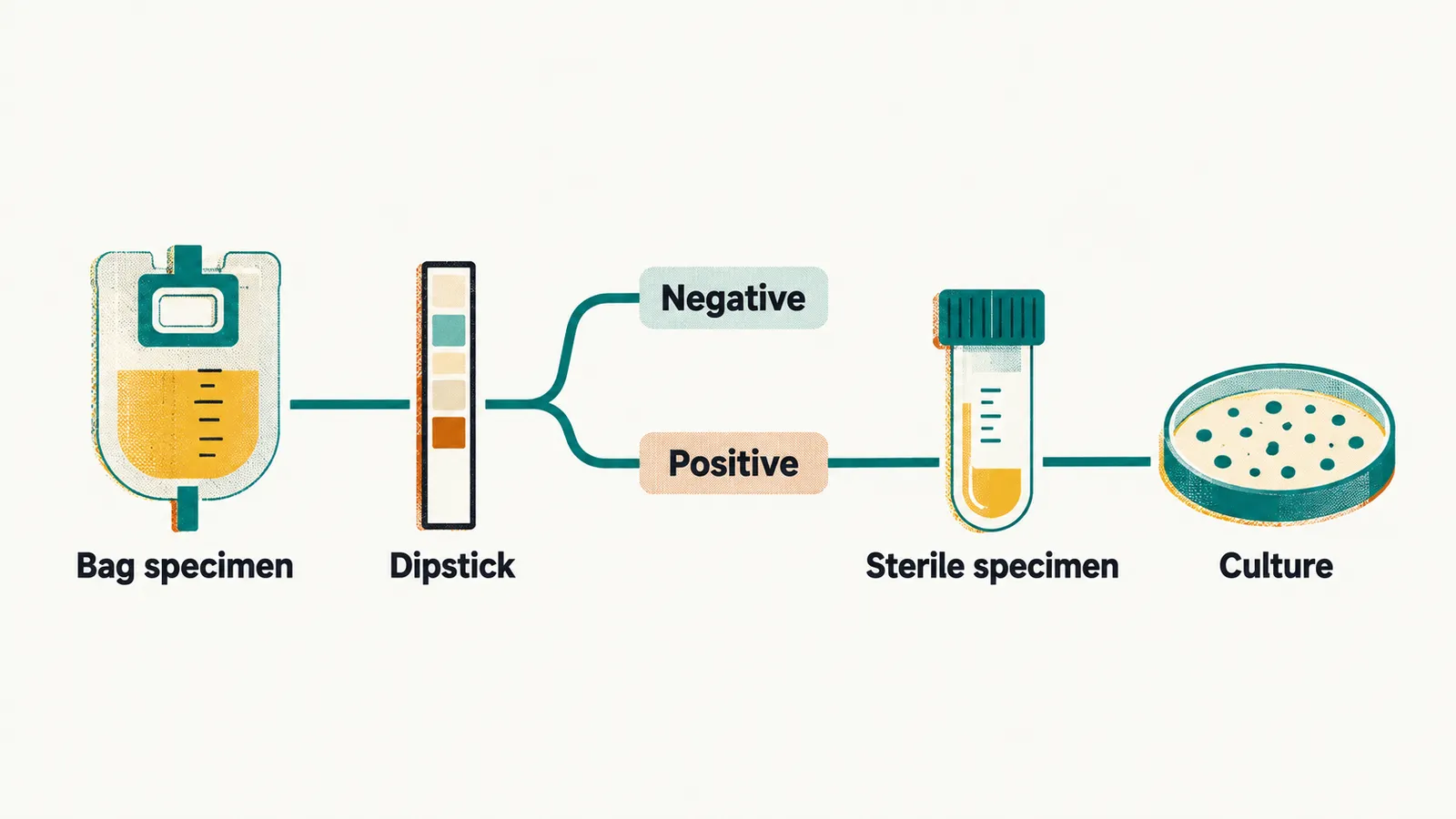
The sequence
- Collect a bag specimen. A sterile collection bag is applied to the perineum after local cleaning and removed as soon as the child voids.
- Run a dipstick on the bag specimen — a reagent strip dipped into the urine that changes colour — reading leukocyte esterase and nitrites.
- If the dipstick is negative, do not culture. The probability of UTI is low enough that a culture adds little.
- If the dipstick is positive, obtain a sterile specimen — clean-catch midstream in a child who can cooperate, catheter in a child who is unwell — and send it for culture.
The logic of the bag step is that the perineal skin is colonised, so the bag collects perineal flora alongside urine. A dipstick tolerates that because it detects the body’s response rather than the organism. A culture does not: it must grow a single organism from a specimen that reflects the bladder, so it needs the second-stage collection.
What the dipstick is measuring
Leukocyte esterase is a proxy for urinary white cells, meaning the bladder has been inflamed enough to recruit neutrophils. It reports the host response, not the bacterium.
Nitrites are produced when Gram-negative bacteria reduce dietary nitrate in the urine. This makes a positive nitrite relatively specific for organisms such as E. coli, Klebsiella and Proteus — but a negative nitrite does not exclude E. coli, because not every E. coli strain reduces nitrate efficiently. Enterococcus and Pseudomonas frequently do not reduce nitrate at all. Positive nitrite is specific, meaning a positive result is seldom false; negative nitrite is not sensitive, meaning infections can still give a negative result.
Two practical consequences follow. Nitrite is generated in the specimen itself, so a sample left at room temperature can become falsely positive as bacteria continue to multiply; urine should be examined promptly. And the combined dipstick performs best as a pair. Its performance is expressed as a likelihood ratio, the factor by which a result multiplies the odds of UTI: values well above 1 raise the odds, values below 1 lower them. A dipstick positive for both leukocyte esterase and nitrite has a pooled positive likelihood ratio of about 28 for UTI, while a dipstick negative for both has a pooled negative likelihood ratio of about 0.2.
When the dipstick is normal and the child still has a UTI
A normal urinalysis does not exclude infection. Children with a positive urine culture but no pyuria (white cells in the urine) sit in an ambiguous zone: some have asymptomatic bacteriuria — bacteria in the urine without an inflammatory response — or a contaminated specimen, and some have genuine infection with a falsely negative screen. Automatic urinalysis has been reported to miss a substantial minority of UTIs in febrile infants and toddlers when pyuria is absent, which is the reason clinical condition, collection method and the decision to treat all enter the final judgement rather than the dipstick alone.
The practical rule is asymmetric. A negative dipstick in a well child can reasonably end the workup. A negative or equivocal dipstick in an unwell febrile child should not by itself stop a culture from being sent, and a positive dipstick always needs confirmation with a sterile sample.
Three ways to get a culture specimen
Whenever a culture is needed, the specimen has to reflect the bladder rather than the skin. Three methods achieve that, and the choice depends on whether the child can cooperate and how unwell they are.
| Method | When it is used | Practical points |
|---|---|---|
| Clean-catch midstream | Cooperative, toilet-trained child | Clean the perineum, discard the first part of the stream to clear urethral flora, catch the middle |
| Catheter specimen | Unwell child, suspected pyelonephritis, urgent sample needed | Invasive and uncomfortable; must be aseptic, since the catheter can introduce organisms |
| Suprapubic aspiration | Rarely used, when catheterisation is not feasible or has failed | Needle aspiration of the bladder through the abdominal wall |
For precontinent infants, who are not yet toilet-trained, bladder stimulation methods can help: gentle suprapubic tapping and lumbar stimulation, or the Quick-Wee variation using gauze soaked in cold fluid applied to the suprapubic area. In a randomised trial this increased the proportion of infants who voided within 5 minutes compared with an unaided clean-catch attempt, which makes the non-invasive route more often successful. Published success rates vary widely between studies and depend on the operator’s technique.
What counts as a positive culture
Culture results are reported in colony-forming units per millilitre (CFU/mL), a count of the bacteria that grow from each millilitre of urine. The threshold for a significant count differs by collection method, because contamination risk differs:
| Specimen | Colony count usually taken as significant |
|---|---|
| Clean-catch or bag | ≥ 100,000 CFU/mL (10⁵) of a single organism |
| Catheter | ≥ 10,000 CFU/mL (10⁴), and often any growth of a single organism |
| Suprapubic aspirate | Any growth of a single organism (≥ 10³) |
Two qualifications prevent over-reading these numbers. Colony counts are interpreted alongside the urinalysis, since pyuria plus a significant single-organism count supports the diagnosis while mixed growth usually indicates contamination. And when the urine is very dilute — low specific gravity — lower counts in the range of 60,000–80,000 CFU/mL of a single organism can still be significant, because the measured concentration is diluted by the larger volume.
The American Academy of Pediatrics guideline for febrile infants and children aged 2–24 months defines UTI as pyuria together with at least 50,000 CFU/mL of a single uropathogen; other guidelines set different thresholds, so the definition in use locally should be the one applied.
Sample before antibiotic
Antibiotics suppress bacterial growth, so a specimen taken after treatment has started frequently comes back sterile or with an uninterpretable result. The order is therefore fixed: collect the specimen first, then give the antibiotic — even in a child who looks unwell, because the child needs both the treatment and the diagnosis.
Treatment still starts before the culture result is available. A child with a febrile UTI is at risk of bacteraemia and urosepsis, and culture takes 24–48 hours. The sequence is specimen, empiric antibiotic, then adjustment when the organism and its susceptibilities are known.
At a glance
- Bag, then dipstick, then culture — and culture only when the dipstick supports it.
- Leukocyte esterase reports the host response; nitrite reports the organism, and a negative nitrite does not exclude E. coli.
- Examine urine promptly, because nitrite is generated in the specimen after collection.
- A normal urinalysis does not exclude UTI, so a sick febrile child still gets a culture.
- Thresholds: ≥ 10⁵ CFU/mL clean-catch, ≥ 10⁴ CFU/mL catheter, any growth from a suprapubic aspirate.
- Specimen first, antibiotic second, in every child.