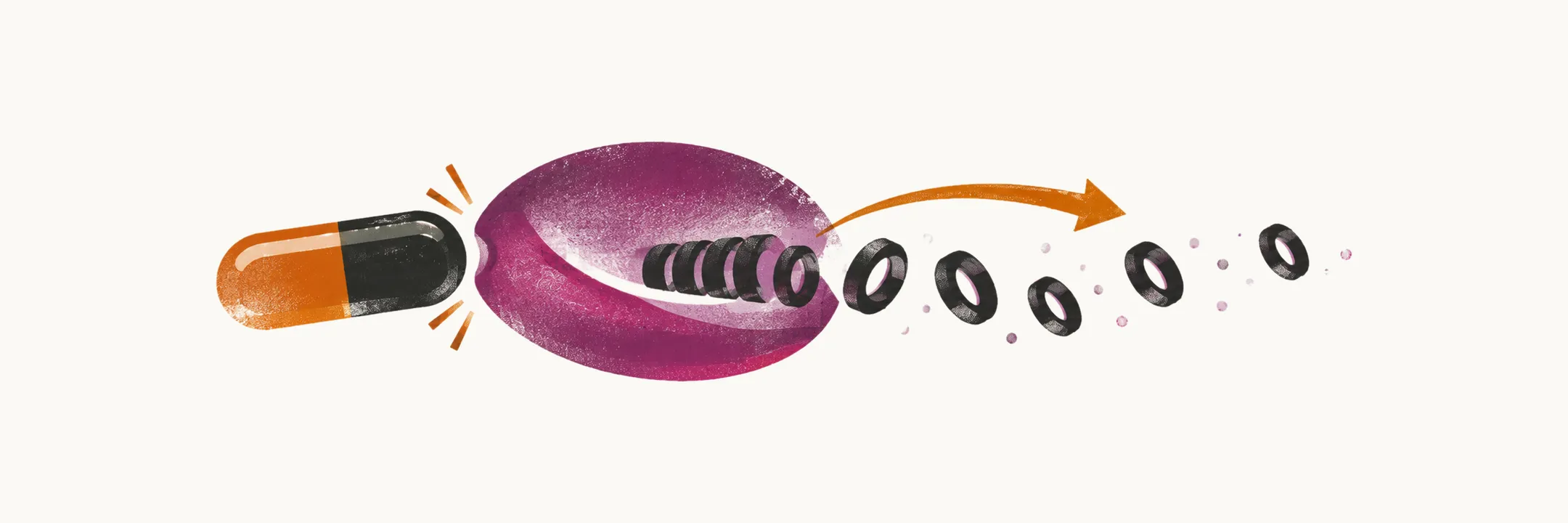
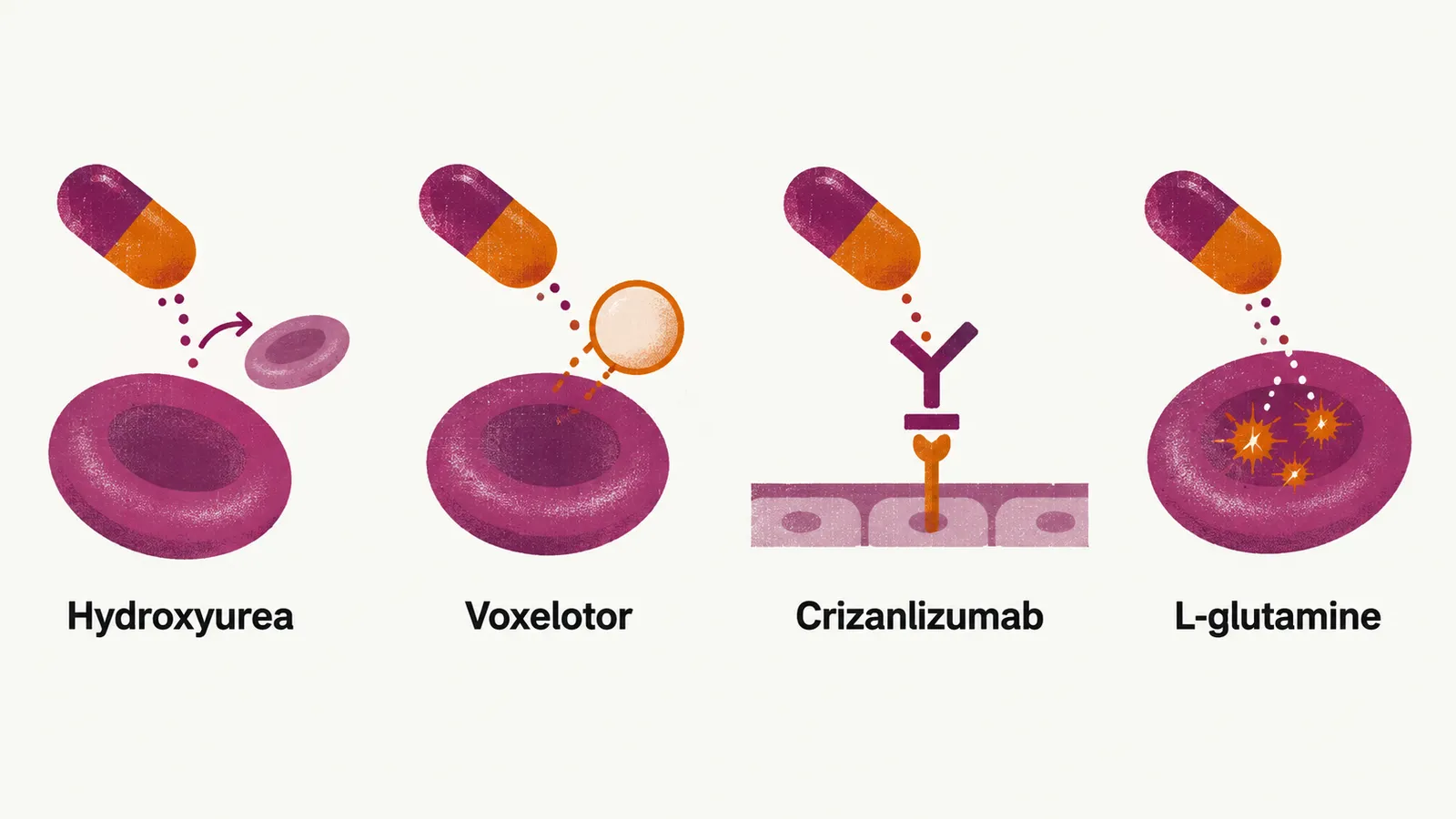
Treatment of sickle cell disease works on two fronts: the drugs that change the disease itself, and the supportive care that these patients need. The drugs act on different steps of the disease: hydroxyurea and voxelotor on the polymerisation of HbS, crizanlizumab on the adhesion of sickle cells to the vessel wall, and L-glutamine on oxidative stress in the cell.
Disease-modifying drugs
Hydroxyurea
Hydroxyurea is a gentle DNA synthesis inhibitor, and it helps in sickle cell disease in several ways at once. It induces the production of HbF, fetal hemoglobin, which does not polymerise; it decreases the production of white blood cells, which dampens inflammation; it increases red cell size, which reduces the MCHC, the concentration of hemoglobin in the red cells; and it is metabolised to nitric oxide, a potent vasodilator. The induction of HbF is the main mechanism by which it relieves the disease, and for all the forms of sickle cell disease the production of HbF is increased with hydroxyurea.
Its effect on HbF is heterocellular, which means that the increase in HbF is not similar in different red cells: some cells gain protection and others do not. Hydroxyurea is recommended at all ages in sickle cell disease. In children it is recommended before 1 year of age, starting at an initial dose of 20 mg/kg with a stepwise increase of the dose, and it leads to an increase of about 33±9.1% of HbF in red cells. In adults it has a modest effect, but still considerable.
Voxelotor
Voxelotor increases the affinity of Hb for oxygen, which prevents the hypoxic polymerisation of HbS. In contrast to hydroxyurea, its effect is pancellular, acting in every red cell, so it can prevent polymerisation more completely. A dose of 1500 mg daily raises Hb by about 1 g/dl and reduces hemolysis by 59%. It was added to hydroxyurea when more prevention of the complications of sickle cell disease was needed. Voxelotor has since been withdrawn from the market, after data indicated that patients taking it had more vaso-occlusive events and more fatal events.
Crizanlizumab
Crizanlizumab prevents adhesion of sickle cells to the endothelial cells by blocking P-selectin molecules. It has no effect on hemolysis; it only prevents the risk of vaso-occlusive events. It was added to the combination of hydroxyurea and voxelotor for a further decrease of the episodes. The marketing authorisation of crizanlizumab was later revoked, after a trial did not confirm a significant reduction in vaso-occlusive crises.
L-glutamine
L-glutamine seems to reduce the oxidative stress in sickle cells. It decreases pain episodes by 25% and hospitalisation by 33%.
Supportive care and prevention
Besides these drugs, these patients need management and support.
Because they are asplenic, infections have to be prevented with immunisation and long-term antibiotic use.
An acute pain episode is treated with strong intravenous opioids — morphine or hydromorphone. NSAIDs are used as an adjunct rather than on their own: a short course of about 5 to 7 days is suggested in addition to the opioid, and ketorolac is one of the NSAIDs used in this way.
Acute chest syndrome is managed with oxygen supplementation and opioid drugs, and antibiotics are given in all cases.
Sickle cell disease is a change in the structure of the β-globin chain. The thalassemias, the other family of hemoglobin disorders, arise instead from too little of one chain being made.