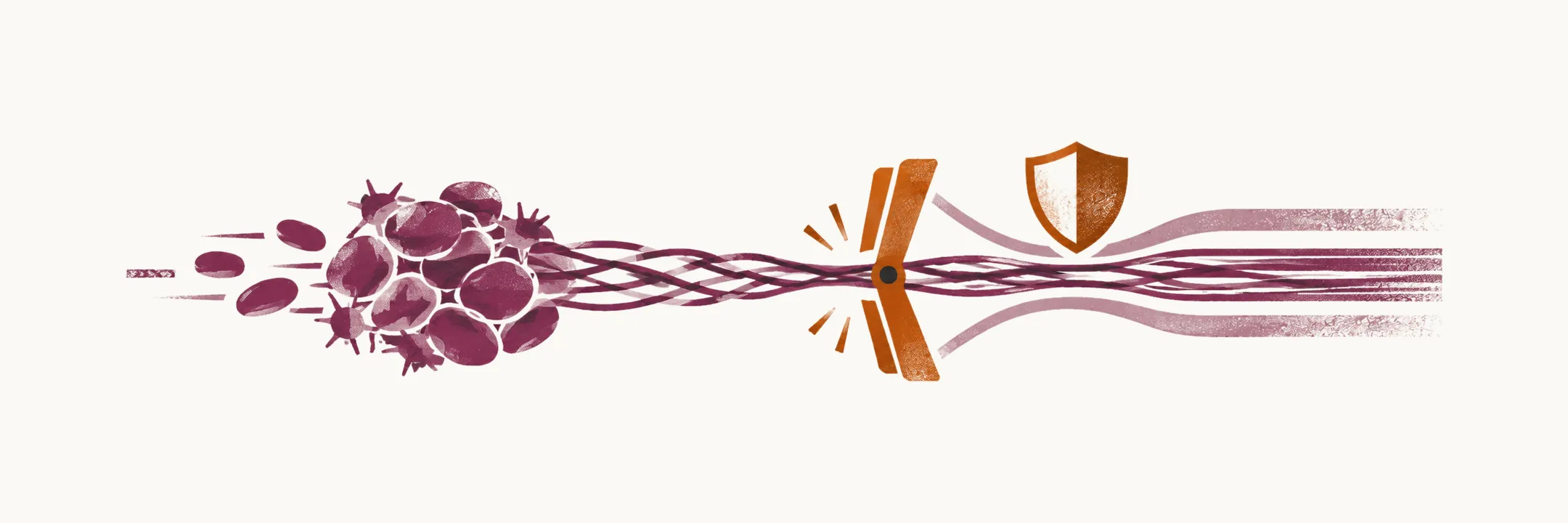
A clot that went on growing would eventually block the vessel it formed in, so coagulation is restrained at every step. Two groups of anti-thrombotic forces do that work: the endothelial cells that line the vessel, and a set of plasma inhibitors. Because these are the natural brakes on clotting, a deficiency in some of them, antithrombin and protein C or protein S in particular, predisposes to abnormal thrombosis.
Endothelial anti-thrombotic activity
The endothelial cells act on three fronts, and each front targets a different stage of clotting.
To limit platelet adhesion, they use prostacyclin, nitric oxide and ectoADPase, or CD39. To limit the coagulation pathways, they use heparan proteoglycan, tissue factor pathway inhibitor (TFPI) and thrombomodulin. The third front is the activation of the fibrinolytic pathways, through three molecules:
- tissue-plasminogen activator, the most relevant of the three, which acts mostly on intravascular fibrinolysis;
- urokinase-plasminogen activator, which is activated mostly in inflammatory conditions and acts on extravascular regions;
- annexin-2.
Antithrombin
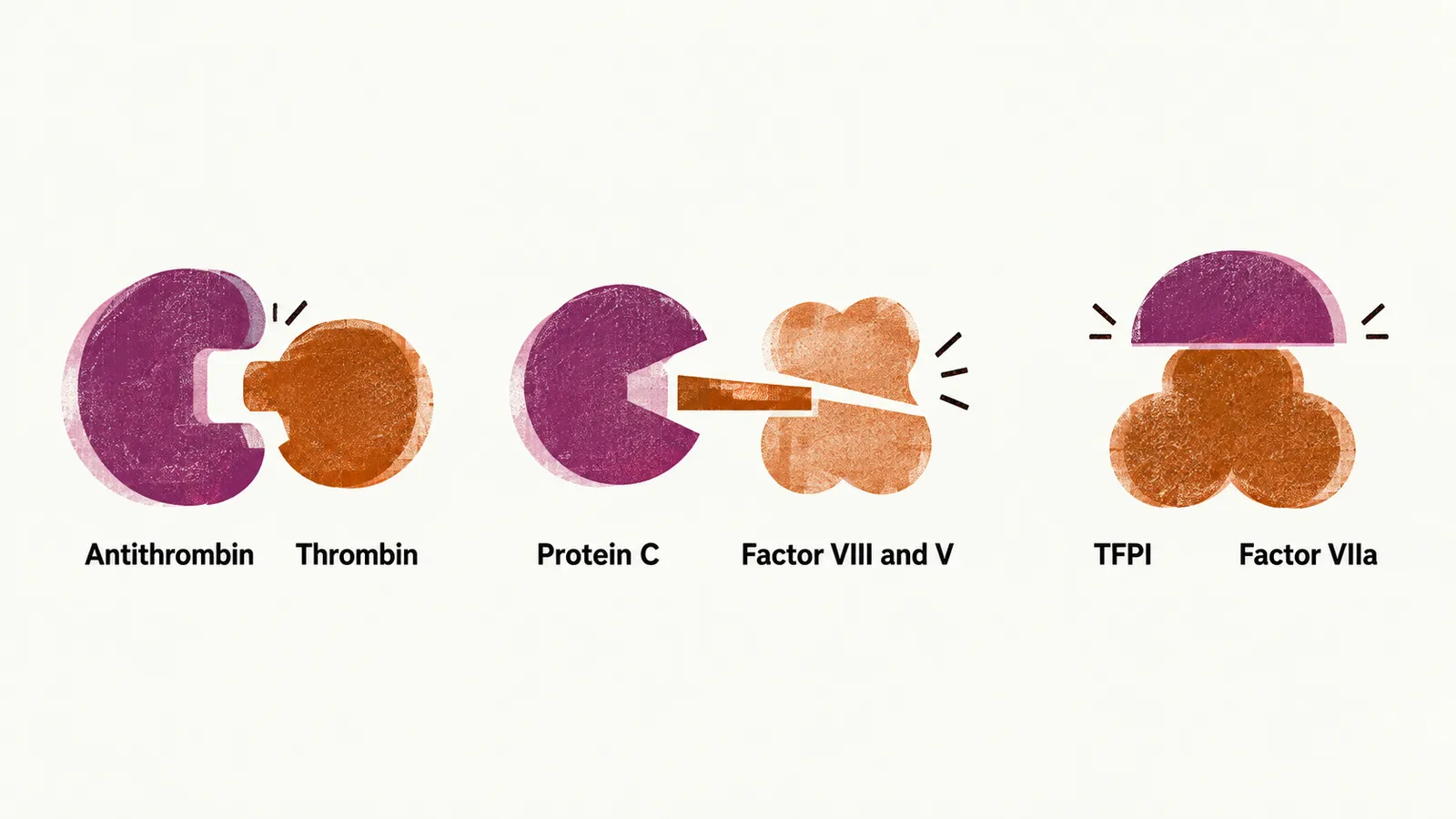
Antithrombin is the major plasma protease inhibitor of thrombin, and it is made by the liver. It neutralises activated coagulation factors, especially thrombin, by forming a complex between its active site and theirs. In the presence of heparin the rate at which these neutralising complexes form rises several thousand-fold, which is why heparin is such an effective anticoagulant. Any inherited deficiency in the normal form of antithrombin predisposes the person to venous thromboembolism.
Protein C
Protein C is a plasma glycoprotein that is made by the liver. It circulates in the inactivated form and is then activated by thrombin. The activation of protein C occurs on the surface of the endothelial cells, in a complex made by the thrombomodulin attached to thrombin together with a receptor for protein C located beside the thrombomodulin, and the activity of this whole complex activates protein C. The activated form of protein C cleaves and inactivates the activated forms of factor VIII and factor V, two of the cofactors the cascade needs. Protein S is the cofactor for protein C in its anticoagulant activity. Any deficiency of protein C or protein S, or resistance to their activity in factor V because of a different site of action that is called factor V Leiden, will make a hypercoagulable state in the patient.
Tissue factor pathway inhibitor (TFPI)
TFPI can be found in the plasma and is made by the endothelial cells. It specifically inhibits the TF–factor VIIa complex of the extrinsic pathway. It is mostly attached to lipoproteins.
These inhibitors stop a clot from growing, but a clot that has already formed still has to be removed. The endothelium also starts that removal, through the plasminogen activators and annexin-2 that switch on fibrinolysis.