
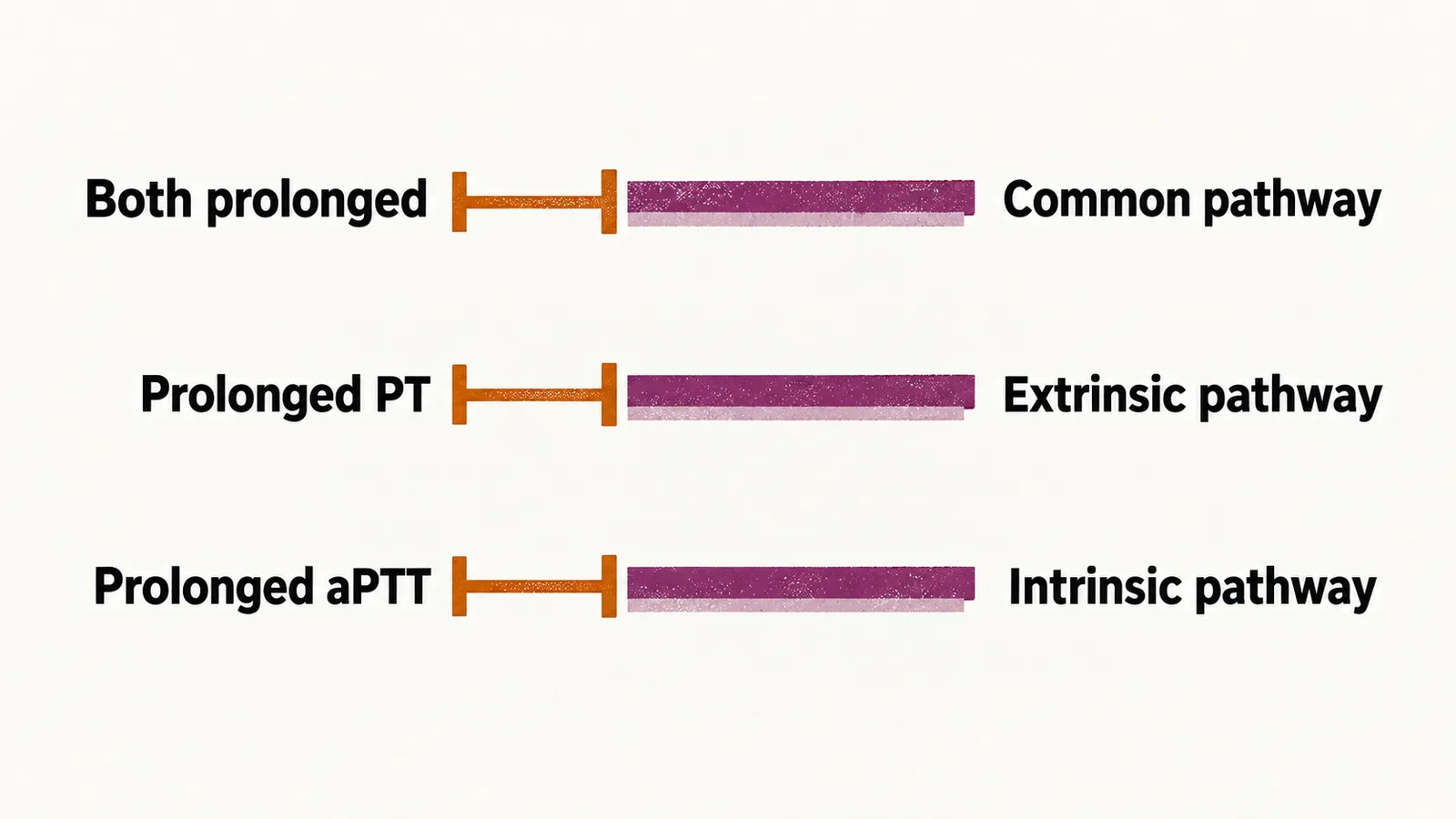
Screening results mean little on their own, because they are read together with the bleeding history. The prothrombin time (PT) reflects the extrinsic pathway and the activated partial thromboplastin time (aPTT) the intrinsic pathway, so the pattern of which one is prolonged points to the part of the cascade at fault. The interpretation is classified on the basis of the history of bleeding and the screening tests.
Positive bleeding history with an abnormal screening test
PT and aPTT both prolonged. This suggests a deficiency or an inhibitor in the common pathway, which is factor II, V, X or fibrinogen, or a combination of deficiencies or inhibitors in both the extrinsic and the intrinsic pathway. The causes fall into three groups:
- Congenital deficiency.
- Acquired causes: factor X deficiency due to amyloidosis; factor II, V, X or fibrinogen deficiency due to the presence of inhibitors, which may be associated with cancer, pregnancy or connective tissue disorders; lupus anticoagulant, which affects factor II; and repeated vascular or cardiac surgeries with repeated infusion of bovine thrombin, which can lead to the formation of an antibody for factor II.
- Other causes: vitamin K deficiency, liver diseases and disseminated intravascular coagulation (DIC), and some drugs, such as the anticoagulants heparin, argatroban, dabigatran and warfarin, and factor X inhibitors such as apixaban, rivaroxaban and edoxaban.
Prolonged PT and normal aPTT. This suggests a deficiency or an inhibitor of the extrinsic pathway. The causes could be a congenital defect of factor VII or the presence of an inhibitor, both of which are very rare. Because of the fact that factor VII has the shortest half-life among the coagulation factors, an isolated prolongation of the PT can also be seen in acute DIC, vitamin K deficiency, the use of warfarin and liver diseases.
Prolonged aPTT and normal PT. This suggests a deficiency or an inhibitor of the intrinsic pathway, such as in factor VIII, IX and XI. The causes could be:
- a severe form of von Willebrand disease (VWD);
- congenital disorders, such as hemophilia A or B, which are X-linked, and congenital deficiency of factor XI, which is usually inherited in an autosomal recessive pattern, although a minority of families show autosomal dominant transmission;
- drugs, such as heparin and some direct inhibitors of thrombin like argatroban and dabigatran;
- acquired inhibitors, which can be made during pregnancy, cancer or connective tissue disorders.
In some plasma cell disorders, heparin-like substances are produced, which are also called heparin-like anticoagulant, or HLAC; they have the same manifestations as heparin, causing prolongation of the aPTT, normal PT, normal reptilase time and prolonged thrombin time.
Positive bleeding history with a normal initial screening test
When the history is positive but the screen is normal, the screen has failed to detect the disorder, and these groups have to be checked for:
- VWD, which is the most common inherited bleeding disorder. Its symptoms are mucocutaneous bleeding, post-surgical bleeding, easy bruising, and, in women, heavy menstrual bleeding, post-partum bleeding and endometriosis. The level of von Willebrand factor (VWF) has to be checked at different periods of time, because the production of VWF is dependent on stress, inflammation, estrogen, exercise and other factors.
- Platelet function disorders. Sometimes platelet dysfunction is secondary to another disorder, such as uremia, cardiopulmonary bypass or a myeloproliferative disorder. The dysfunction of the platelets could be due to aggregation problems, such as Glanzmann thrombasthenia and Bernard-Soulier syndrome. The main laboratory tests to control the function of platelets are aggregometry, the PFA-100, genetic tests, and the electron microscope for the control of the granules in the platelets.
- Tests for fibrin cross-linking by factor XIII. The main sign is delayed bleeding, which can also be seen in fibrinolysis disorders, such as the presence of an antibody against α2-antiplasmin or against plasminogen activator inhibitor-1.
- Vascular or connective tissue disorders, such as HHT, scurvy, EDS and osteogenesis imperfecta.