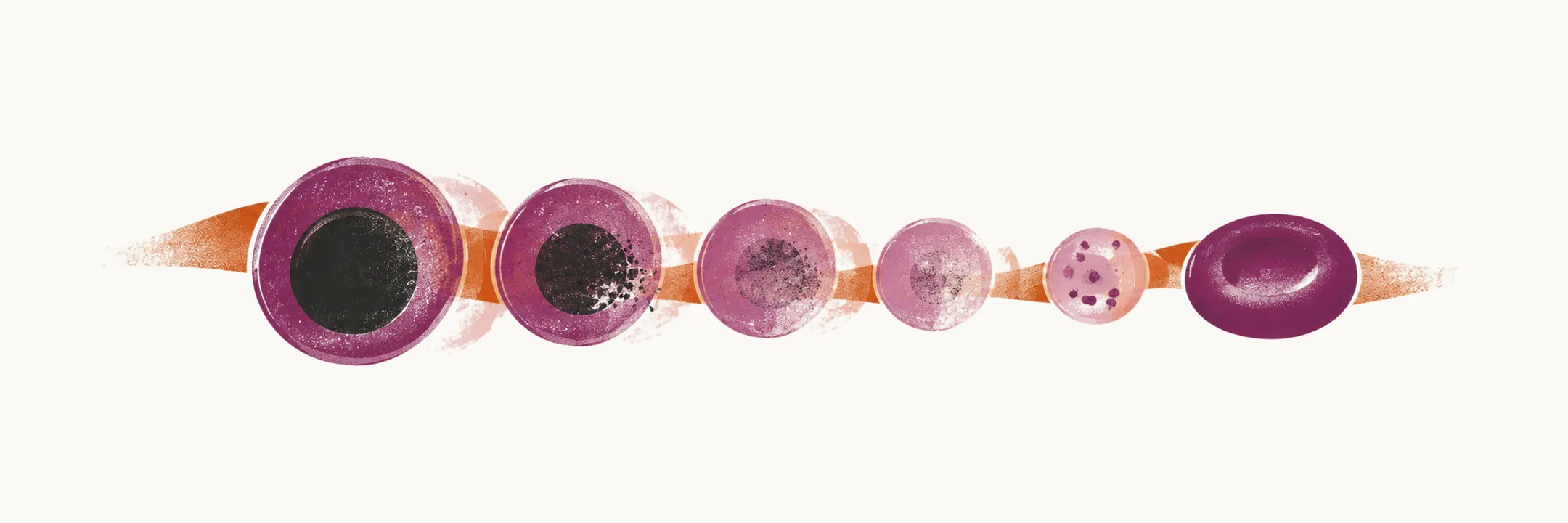
Erythropoiesis is the process that produces red blood cells (RBCs) from the myeloid progenitor cells in the bone marrow. The cells change in size and in how they stain as they mature, and one of them, the reticulocyte, is the newest red cell to reach the blood. Counting reticulocytes is how the marrow’s response to anemia is judged.
From the pro-erythroblast to the red cell
The first cell made from the myeloid progenitor cells in this pathway is the pro-erythroblast, a large cell that stains basophilic. As maturation proceeds the cells become smaller and more acidophilic, until they reach the mature red cell.
How the cell looks under the microscope also shows what it is doing. A cytoplasm that stains darker is carrying out more translation (making protein), because it is full of the ribosomes that make hemoglobin. A nucleus that appears lighter is carrying out more transcription (copying genes into RNA).
The reticulocyte
The reticulocytes are the first anucleated cells in the pathway to the mature red cell. They still contain ribosomes and keep a minimal capacity for RNA production, and it is the ribosomes that allow them to be identified.
To distinguish reticulocytes in the peripheral blood, a supravital stain such as methylene blue is used: it stains the ribosomes that mature red cells no longer have. Reticulocytes are not biconcave and do not have the pale central region of a mature red cell, so a higher reticulocyte count makes the stained film look more coloured; this appearance is called polychromatophilia.
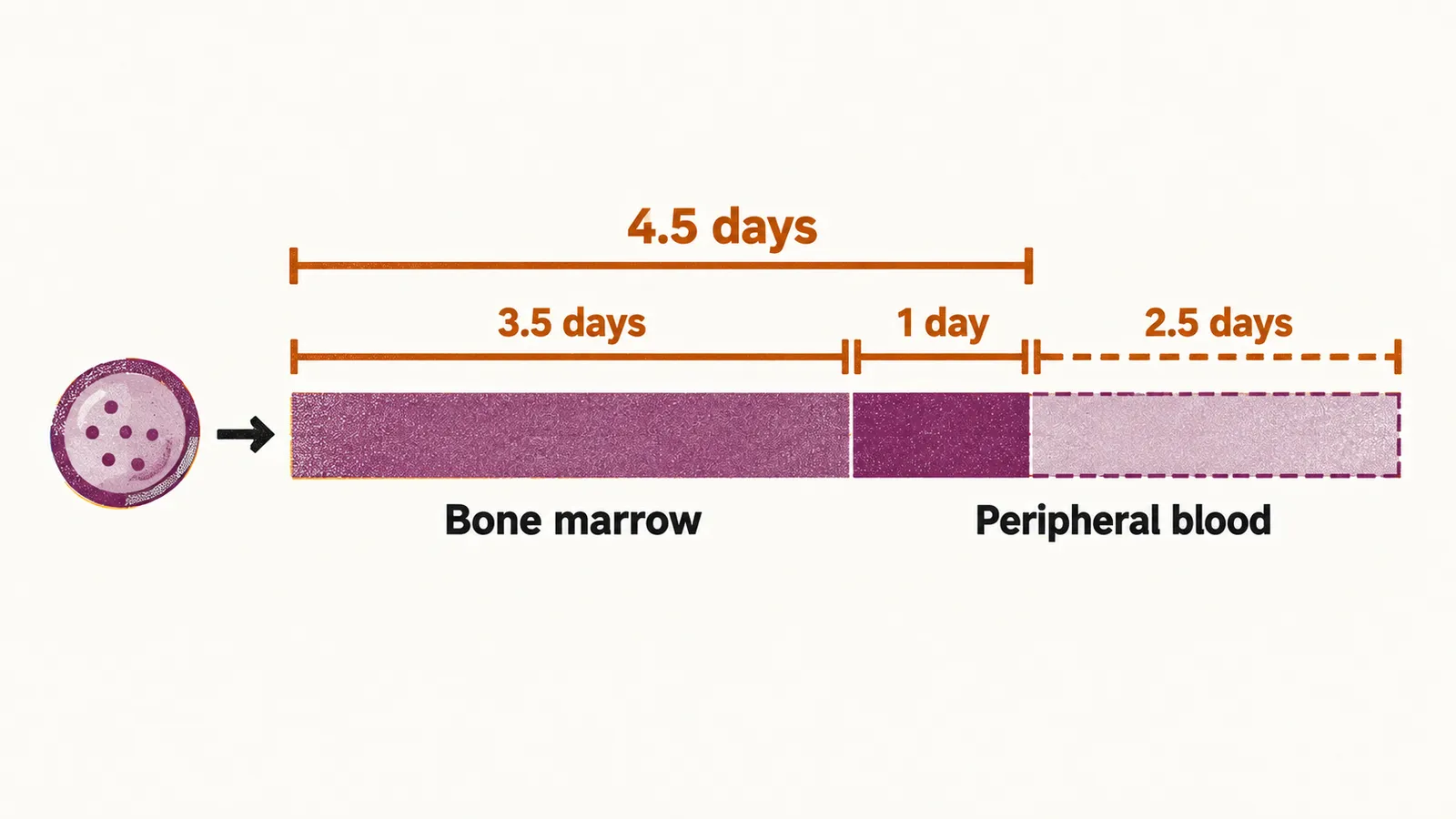
A reticulocyte takes about 4.5 days to mature in total. In normal conditions about 3.5 days of that are spent in the bone marrow and about 1 day in the peripheral blood; when the anemia worsens, the reticulocytes leave the marrow earlier, so the time they spend in the blood lengthens from about 1 day to about 2.5 days.
Reading the reticulocyte count
The reticulocyte count is a percentage, so it rises both when the marrow makes more reticulocytes and when there are fewer mature red cells to dilute them, and a cell released early from the marrow goes on being counted as a reticulocyte for longer. For both of those last reasons the raw count overstates red cell production in anemia. The count is therefore corrected to a standard hematocrit of 45% to give the reticulocyte index, which is read against the degree of the anemia: an index below 2 points to an inadequate response, and an index above 3 to an appropriate one.
This is why a count has to be judged against the hematocrit rather than on its own. At a hematocrit of about 25%, a reticulocyte count about 2.5 times the normal count of about 1% gives an index of about 1.4, still below 2, so it does not represent an adequate response; a count of only about 1.5 times normal is worse still.
A reticulocyte count that is low for the degree of the anemia is what makes an anemia hypoproliferative, the group iron deficiency belongs to. Iron is one of the supplies the developing erythroid cells depend on, and how it is carried to them is the next question.