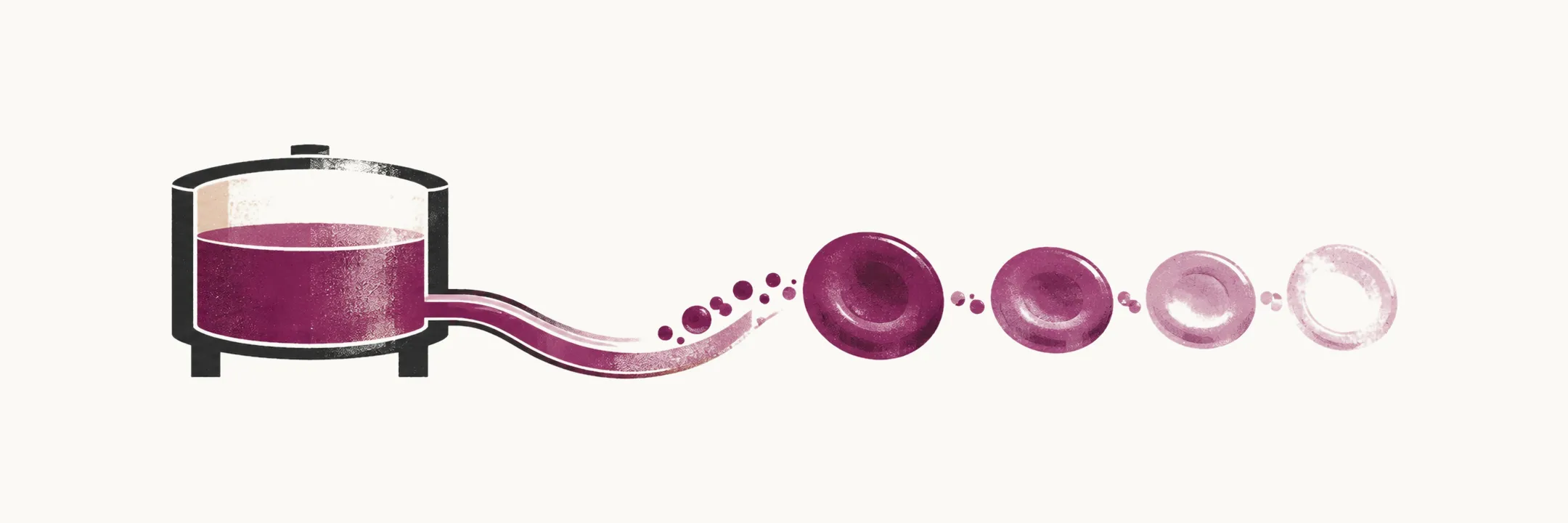
Iron deficiency develops in stages: the stores are lost first, then the supply of iron to the marrow becomes insufficient, and only then does the hemoglobin fall. This progression is why the blood count can still be normal in a person who is already in negative iron balance.
Hemoglobin synthesis holds up while serum iron is normal
As long as the serum iron remains in the normal range, hemoglobin synthesis is not affected, even by a decrease in the iron stored inside the reticuloendothelial system. The stores buffer the marrow while they last, so the hemoglobin falls only once they can no longer keep the serum iron up.
The three stages
Five laboratory terms mark the stages. Serum ferritin reflects the iron stores. Serum iron is the circulating iron bound to transferrin, and the transferrin level is measured indirectly as the total iron-binding capacity (TIBC). Transferrin saturation is the ratio of serum iron to TIBC. Red cell protoporphyrin is an intermediate in the production of heme, and its level rises when heme synthesis is impaired.
| Stage | What happens | Laboratory picture |
|---|---|---|
| Negative iron balance | the demand for iron, or the loss of iron from the body, exceeds the ability of the body to absorb iron; blood loss, pregnancy, the rapid growth of adolescence and an inadequate dietary intake are the usual causes | the iron stores fall, which is reflected by the serum ferritin; the serum iron and the red cell protoporphyrin level remain normal, and the transferrin (TIBC) rises as absorption increases |
| Iron-deficient erythropoiesis | the transferrin saturation reaches 15-20% and hemoglobin synthesis becomes impaired | hypochromic microcytic red cells gradually appear on the peripheral blood smear |
| Iron-deficiency anemia | the hemoglobin level falls, and the transferrin saturation is lower than 10-15% | moderate anemia (hemoglobin between 10-13 g/dL) with a hypoproliferative marrow; severe anemia (hemoglobin about 7-8 g/dL) with microcytic hypochromic cells and misshapen cells such as pencil cells, and erythroid hyperplasia if severe anemia lasts a long time |
Blood loss is the commonest cause of a negative balance: if the blood loss exceeds 10-20 mL/day, the body is not able to absorb enough iron from the gut to replace it. Pregnancy, the high rate of development in adolescence and an inadequate dietary intake all raise the requirement in the same way.
The stage matters clinically because a normal blood count does not exclude iron deficiency: the stores, and after them the supply of iron to the marrow, are lost before the hemoglobin falls.