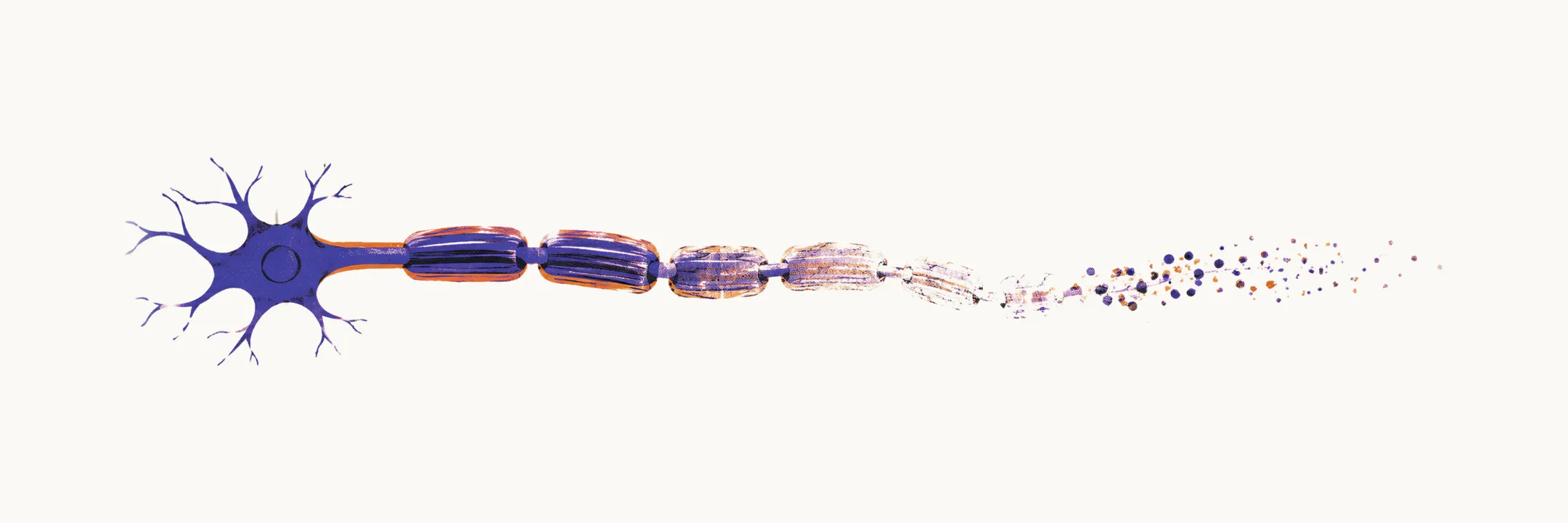
Polyneuropathy is symmetric, length-dependent nerve damage that usually starts in the feet and marches upward in a stocking-glove pattern. Faced with one, the efficient move is to classify it along four axes, because each axis cuts the differential immediately.
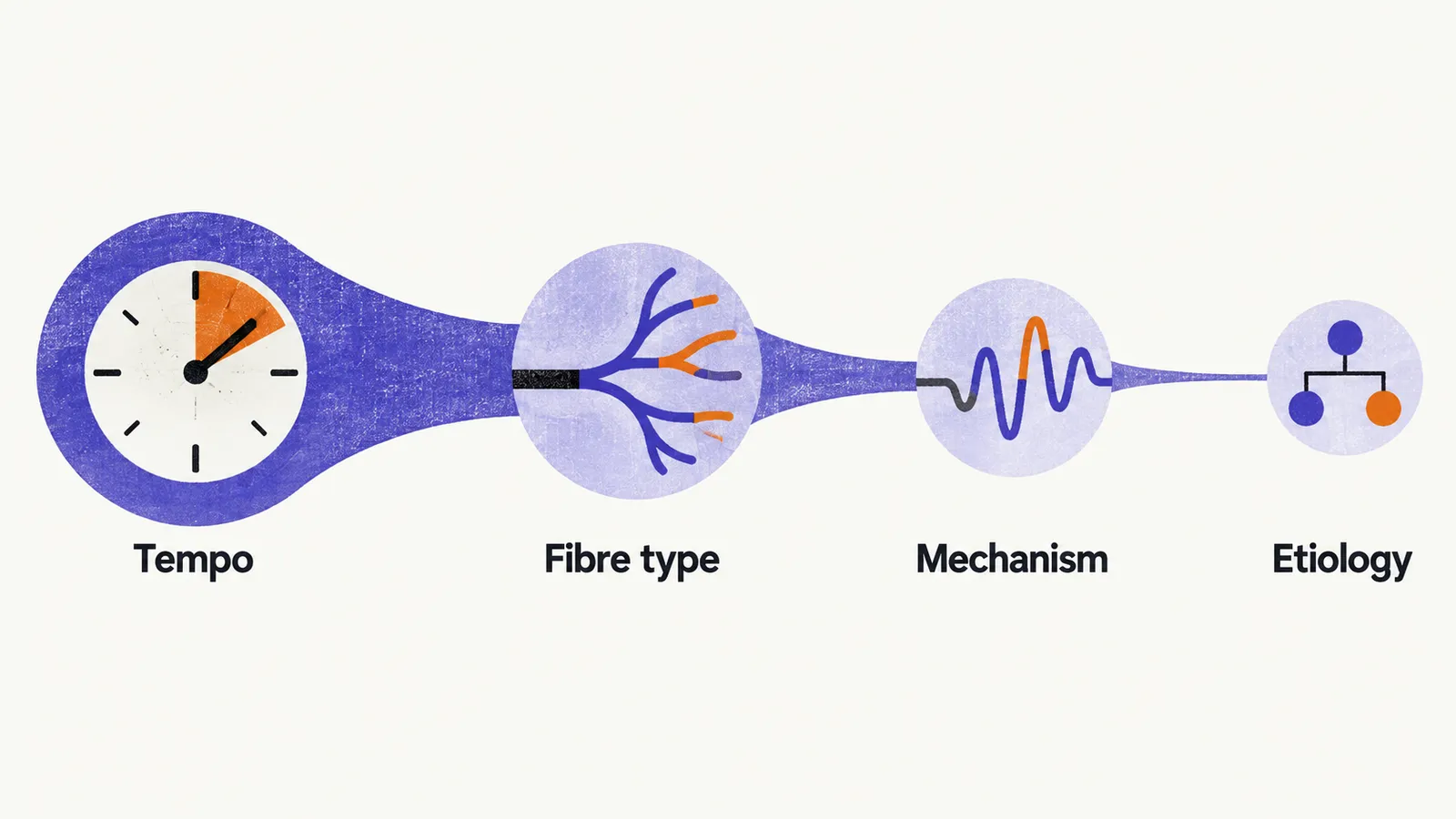
Axis 1: tempo
Tempo, the speed at which symptoms develop and progress, is the first axis.
| Tempo | Examples |
|---|---|
| Acute (days to weeks) | Guillain-Barre syndrome, diphtheria, acute intermittent porphyria, vasculitis |
| Subacute (weeks to months) | Toxic, paraneoplastic, nutritional deficiency |
| Chronic (months to years) | Charcot-Marie-Tooth disease, diabetic neuropathy, CIDP (chronic inflammatory demyelinating polyradiculoneuropathy) |
Tempo is the urgency axis. Acute ascending weakness is Guillain-Barre syndrome until proven otherwise, and it is covered under Guillain-Barre syndrome.
Axis 2: fibre type
Fibre type asks which functions are affected, because sensory, motor, and autonomic fibres fail in different combinations.
- Purely sensory: numbness, pain, or ataxia without weakness.
- Purely motor: weakness without sensory loss, which narrows the field to multifocal motor neuropathy, some Guillain-Barre variants, and porphyria.
- Autonomic: orthostatic hypotension, bowel or bladder dysfunction, abnormal sweating.
- Mixed sensorimotor with autonomic features: the most common pattern, seen in diabetes and most chronic neuropathies.
Autonomic signs alongside sensory symptoms point most often toward diabetes or amyloidosis.
Axis 3: mechanism
Demyelinating disease slows conduction velocity on nerve conduction studies and suggests Guillain-Barre syndrome, CIDP, Charcot-Marie-Tooth type 1, or anti-MAG (myelin-associated glycoprotein) neuropathy. Axonal disease lowers amplitudes with relatively preserved velocity and suggests diabetes, alcohol, toxins, or Charcot-Marie-Tooth type 2. Many chronic neuropathies show a mixed picture. One specific pattern deserves attention: demyelination with disproportionately prolonged distal latencies relative to conduction slowing points toward anti-MAG neuropathy rather than generic CIDP. How these signatures are measured is covered under nerve conduction studies and EMG.
Axis 4: etiology, acquired or inherited
Etiology asks whether the neuropathy is acquired or inherited, and which specific cause is responsible.
Acute polyneuropathies divide into demyelinating causes (Guillain-Barre syndrome, diphtheria, acute-onset CIDP) and axonal causes (vasculitis, toxins such as vincristine or thallium, acute intermittent porphyria).
Chronic hereditary disease is dominated by Charcot-Marie-Tooth disease, and familial amyloidosis from transthyretin (TTR) mutations produces a progressive small-fibre-predominant neuropathy with autonomic failure. The genetics and clinical picture of both are covered under hereditary neuropathies.
Chronic acquired disease clusters by mechanism:
- Demyelinating causes include CIDP, anti-MAG neuropathy, hypothyroidism, amiodarone or lead toxicity, leprosy, and Lyme disease.
- Axonal causes include diabetes, uremia, alcohol, vitamin B1, B6, B12, or E deficiency, HIV and hepatitis C infection, vasculitis, cryoglobulinemia, Sjogren syndrome, and paraneoplastic syndromes. In paraneoplastic disease, a severe subacute sensory neuropathy with ataxia can precede any tumor diagnosis.
Diabetes is the single most common identified cause of polyneuropathy. A substantial minority of chronic cases remain idiopathic after workup, and genetic testing continues to reclassify some of these as inherited.
Extranervous clues
The fastest diagnostic shortcut is often the general examination rather than the next test.
| System | Finding | Consider |
|---|---|---|
| Gut | Persistent diarrhea | Inflammatory bowel disease, celiac disease, amyloidosis, arsenic or thallium |
| Gut | Persistent constipation or vomiting | Lead, porphyria, amyloidosis, acute metal intoxication |
| Skin | Purpura | Vasculitis, cryoglobulinemia, and therefore hepatitis C testing |
| Skin | Bullous lesions or hyperpigmentation | Porphyria, chronic arsenic exposure |
| Blood | Anemia | B12 deficiency, myeloma, amyloidosis, lead or arsenic |
| Blood | Monoclonal protein or lymphadenopathy | Plasma cell disorders, HIV, lymphoma, amyloidosis |
Small-fibre neuropathy
One pattern is easy to miss at the bedside: burning feet with normal reflexes, normal strength, and a normal EMG. It is easy to dismiss, because routine conduction studies may be completely normal. The pattern is covered under small-fibre neuropathy.