
A preterm infant is a baby born before 37 completed weeks of gestation. Gestational age is the clearest single signal of how much development birth interrupted: it tells us how far the lungs, brain, gut, respiratory control centers, skin and cardiovascular transition had come before the placenta stopped supporting the infant. Birth weight modifies risk but does not replace gestational age, because a term infant and a of the same weight do not have the same organ maturity. When birth weight is low for gestational age, a growth problem is added on top of the maturity problem, and both must be read from the chart.
The relationship that organizes the whole topic is that mortality and both acute and chronic morbidity rise as gestational age falls. The gradient is steepest near the limit of viability, the earliest gestations at which survival outside the uterus is possible, where survival and neurodevelopmental outcome depend heavily on whether active intensive care was offered and on the quality of that care.
Preterm birth is common, and its scale has been stable: an estimated 13.4 million infants were born before 37 weeks in 2020, about 9.9% of all live births worldwide, and the global rate changed little between 2010 and 2020. That number is a starting point rather than a prognosis, because the risk attached to it depends almost entirely on how early the birth occurred.
The prematurity bands
The World Health Organization defines preterm birth as birth before 37 completed weeks and splits it by gestational age. Research and clinical services commonly divide the upper band further, because an infant born at 33 weeks and one born at 36 weeks do not carry the same risks.
| Band | Gestational age |
|---|---|
| Extremely preterm | below 28 weeks |
| Very preterm | 28 to below 32 weeks |
| Moderate to late preterm (WHO) | 32 to below 37 weeks |
| Moderate preterm (common subdivision) | 32 to below 34 weeks |
| Late preterm (common subdivision) | 34 to below 37 weeks |
Saying only “preterm” discards most of the prognostic information. The bands also predict the kind of help the infant will need: very and infants usually need neonatal intensive care because several organ systems fail together, while infants often need close monitoring, thermal support, glucose surveillance, feeding support and jaundice follow-up rather than mechanical ventilation.
The risk gradient
One large recent dataset comes from the Vermont Oxford Network for 2020–2022 and describes all inborn infants (those born in the same hospital rather than transferred after birth) at United States level III–IV neonatal units, which provide the highest levels of neonatal intensive care. Survival to hospital discharge was about 25% at 22 weeks, 53% at 23 weeks, 71% at 24 weeks and 82% at 25 weeks. Those denominators include infants who died in the delivery room; among infants who received postnatal life support the figures were slightly higher. An international comparison of 11 neonatal networks found survival at 22 weeks ranging from 9% to 64% and at 23 weeks from 16% to 80%.
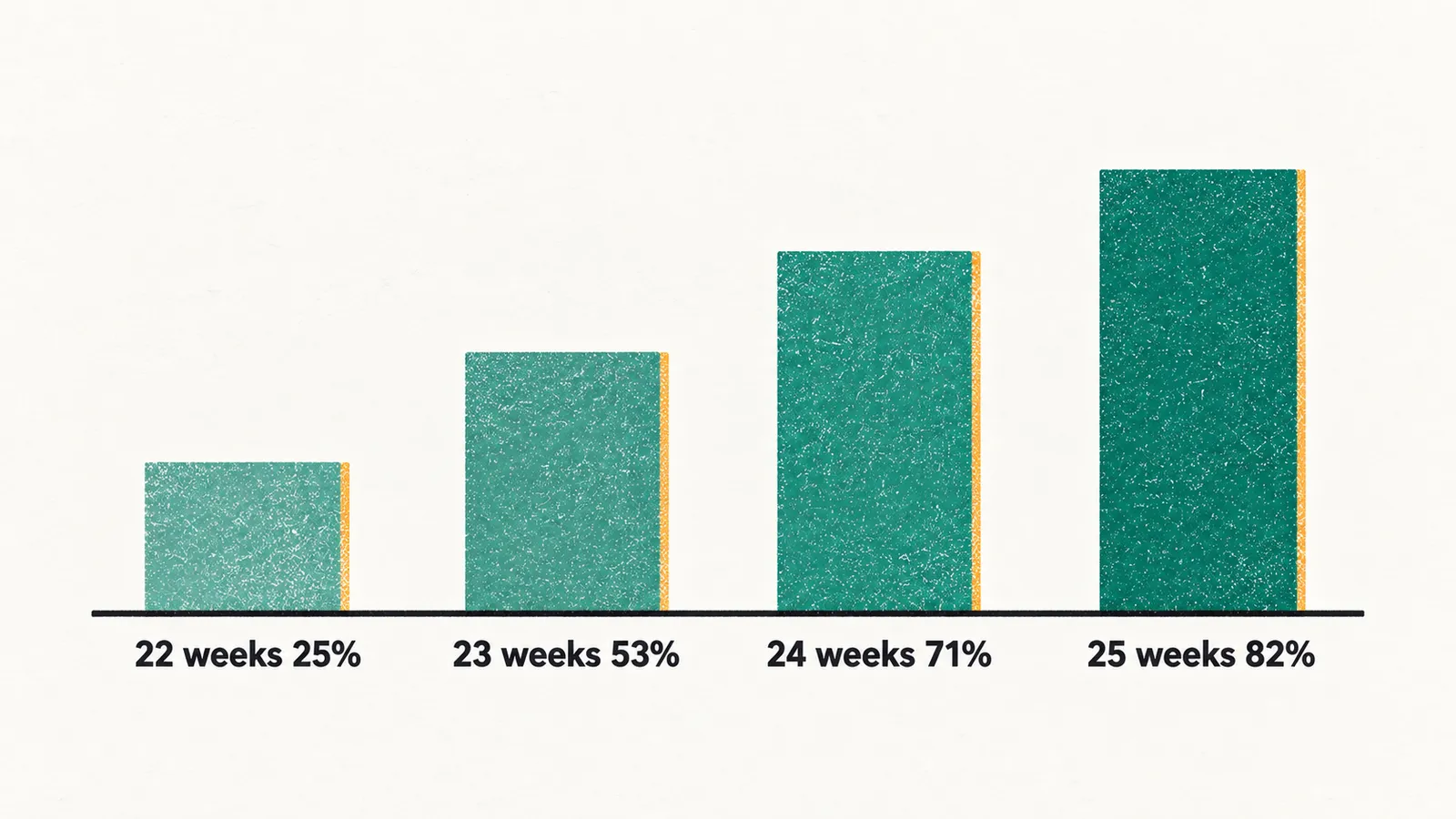
Two practical conclusions follow. First, a single survival percentage does not describe an individual infant’s prognosis, because era, definitions, population, hospital policy and the offer of active treatment all shift the number. Second, the gradient itself is the stable finding: each additional week of gestation adds substantially to organ maturity, and the gain is largest at the earliest gestations.
The late-preterm trap
Late-preterm infants are the largest group and the easiest to underestimate: in high-income countries they account for roughly two-thirds to three-quarters of all preterm births. The old label “near term” was abandoned because it encouraged false reassurance. A 34- to 36-week infant may have term-like weight and appearance, yet has more respiratory morbidity, apnea, temperature instability, hypoglycemia and other metabolic problems, jaundice, infection and feeding difficulty than an infant born at term.
Feeding difficulty has a developmental substrate rather than a behavioral cause. Coordinated sucking, swallowing and breathing is not reliably established until about 34 weeks , so an infant born just before that threshold may take feeds poorly even when there is no neurological or gastrointestinal disease.
The resulting pattern is an infant who looks term but behaves preterm. The clinical danger is not the label; it is reducing monitoring or planning discharge before breathing, temperature, feeding and weight trend are stable. The same caution extends to births at 37 to 38 weeks, which also carry higher risk than births at 39 to 40 weeks.
Chronological age, postmenstrual age and corrected age
After birth a child has a chronological age measured from the date of birth. A preterm infant also has a maturity clock that keeps running toward the estimated date of delivery. While the infant is still before term, that maturity is described as postmenstrual age (gestational age plus completed weeks since birth). After the expected term date, the clinical comparison uses corrected age:
corrected age = chronological age − weeks born before 40 weeks
A baby born at 28 weeks was born 12 weeks before the expected 40-week date, so at 12 months of chronological age that child is about 9 months corrected age.
The correction matters because milestones depend on neural and organ maturation, not only on time spent outside the uterus. Judging a 28-week infant by chronological age alone can make normal maturation look like developmental delay. Standard practice is to use corrected age for developmental and growth assessment through at least the first year, and into the second year for more immature infants; for extremely and very preterm children, growth assessment may need age correction out to 36 months. Administrative records still use chronological age, so the two ages coexist and must be labelled whenever they are reported.
Why the risk is systemic rather than organ-specific
Preterm birth abruptly removes placental gas exchange, continuous transplacental nutrition, thermal protection and a low-stimulation environment. The lungs must aerate before their architecture and surfactant system are mature; the ductus arteriosus, the fetal vessel that lets blood bypass the lungs, must close while hypoxia and prostaglandin activity (vasodilating mediators that hold it open) still favor patency; the gut must accept milk before it was scheduled to; and the developing brain and retina are exposed to oxygen swings, light, noise, pain and hemodynamic instability.
That shared substrate explains why the same infant may develop respiratory distress, apnea (pauses in breathing), patent ductus arteriosus, feeding failure, infection, , retinal injury and white-matter or hemorrhagic brain injury, and why the number of coexisting problems grows as gestational age falls. The complications interact rather than simply accumulating, which is why they are best learned together rather than as separate diseases.