The golden hour is the first hour after birth, when an immature infant has to switch from placental support to independent breathing, circulation, temperature control and metabolism. In a term infant those transitions are usually automatic. In a they become a coordinated stabilization problem, because every organ is adapting before it is ready and each system can pull the others down.
Breathing is the first priority, but the hour is not only about the lungs. Oxygenation, blood pressure, temperature, glucose, vascular access, placental transfusion, transport and communication with the family all contribute to survival and to later morbidity.
Where the birth happens is a clinical decision made before delivery
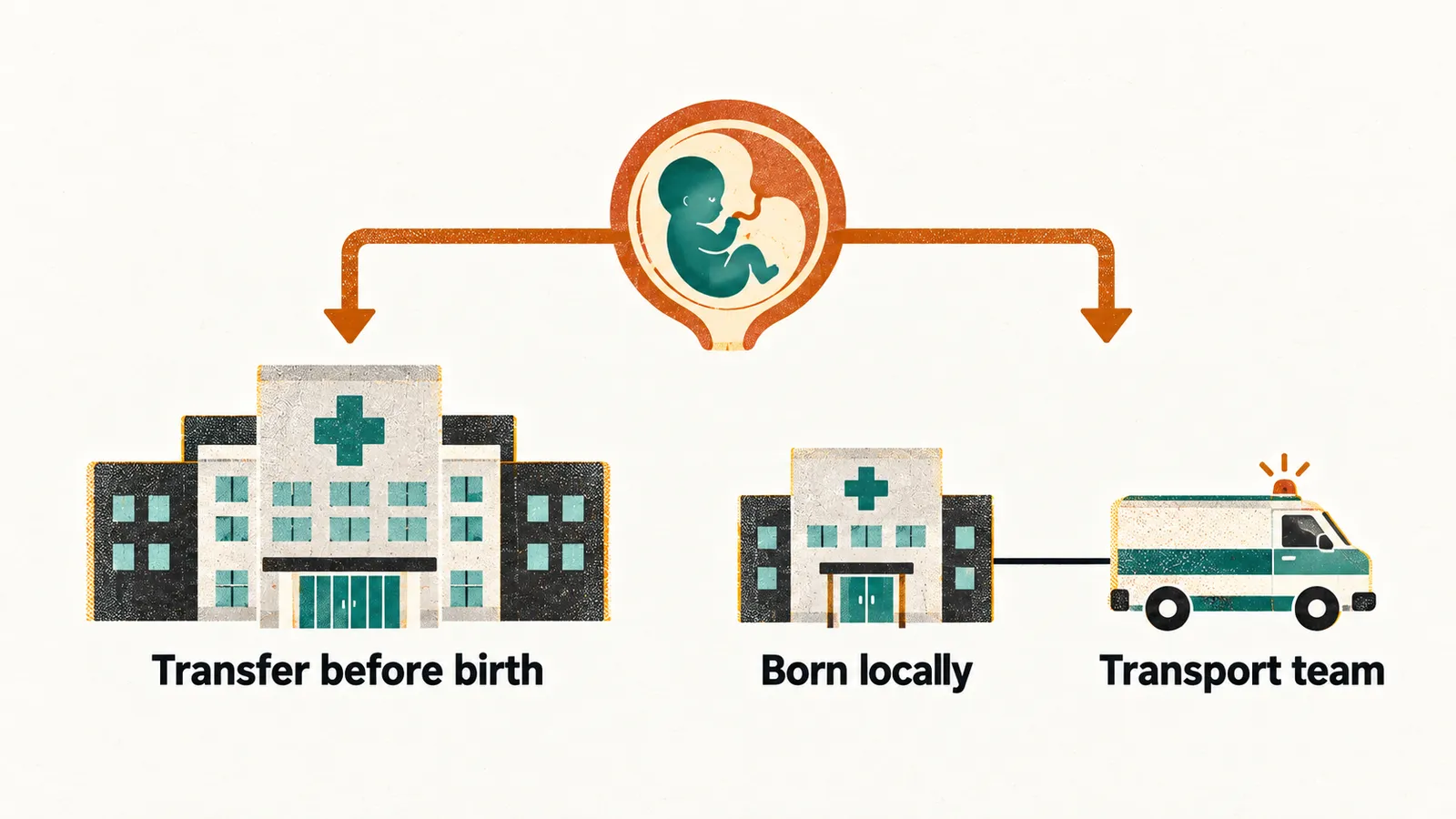
Regional perinatal networks exist so that very preterm birth does not happen in a hospital without neonatal intensive care. When preterm delivery is expected and the mother is stable enough to move, the safer strategy is usually to transfer the pregnant woman to a center with both high-level obstetric and neonatal services, where delivery can be planned and prepared for.
If transfer before birth is unsafe, or labor is too advanced, the infant is born locally and a dedicated neonatal transport team travels to the hospital, stabilizes the infant and moves the infant to a neonatal intensive care unit (NICU). Transporting a critically ill, ventilated preterm infant after birth is technically difficult and adds physiological stress during a period of particular brain and cardiorespiratory vulnerability — which is why maternal transfer is preferred whenever it is feasible.
Because unexpected preterm delivery can occur in any hospital, every professional who may attend a delivery needs the skills to begin neonatal resuscitation. The specialist team may be en route, but the first minutes cannot wait for it.
Respiratory support begins gently
A preterm infant may not establish effective breathing because the respiratory center, lung architecture and surfactant system are immature. Lung-fluid clearance is slower after preterm birth, surfactant (the substance that keeps small airspaces from collapsing) is limited, the chest wall is compliant and the muscles tire quickly, so the same transition that a term infant completes unaided can fail in a few minutes.
Initial support therefore aims to aerate the lung while avoiding unnecessary invasive ventilation. That usually means positive-pressure support through a face mask or a nasal interface, escalating to intubation (placing a tube into the trachea) and mechanical ventilation when the infant cannot be stabilized or sustained on non-invasive support.
Cord management during the transition
At birth the umbilical cord still connects the infant to the placenta, so the timing of clamping is part of the transition. When the infant does not need immediate positive-pressure ventilation, current guidance is not to clamp the umbilical cord earlier than 1 minute after birth, and deferring clamping allows placental blood to continue supporting preload (the blood returning to fill the heart) and perfusion while the lungs begin to aerate. In preterm infants, a delay of at least 30 to 60 seconds is associated in meta-analyses with lower mortality before discharge and less intraventricular hemorrhage (bleeding into the ventricles of the brain). The effect sizes vary between studies, and immediate clamping remains necessary when the infant requires ventilation or when the cord is compromised.
The practical difficulty is that a preterm infant who needs support may also benefit from an intact cord. Specialized resuscitation platforms that can be moved next to the mother allow stabilization to begin before clamping, but they require equipment, space and a trained team, so this is a planned capability rather than an improvisation.
Cold stress becomes metabolic failure
A preterm infant has thin skin, little subcutaneous fat and a high surface-area-to-mass ratio, so heat is lost quickly by evaporation, conduction, convection and radiation. raises oxygen consumption and glucose use at exactly the moment when respiratory reserve and energy stores are lowest. Hypothermia on admission to the NICU is associated with higher mortality, and thermal management is therefore treated as a resuscitation intervention rather than a comfort measure.
The measures differ by infant. A vigorous term infant is dried and placed skin to skin. During active resuscitation of a very preterm infant, skin-to-skin contact is not practical, and thermal care instead uses a heated mattress or bed, continuous temperature monitoring, a hat because the head is proportionally large, and a plastic wrap or bag for infants below about 28 weeks to limit evaporative loss. Delivery rooms are warmed and draughts are avoided.
Monitoring that changes what you do
Each of these transitions can fail within minutes, and several fail without obvious signs. Monitoring in the delivery room and on admission therefore follows the physiology, and each measurement guides a specific adjustment:
- Preductal oxygen saturation, measured on the right hand, reports blood that has not passed the ductus arteriosus (the fetal vessel between the pulmonary artery and the aorta) and is used to titrate oxygen. Supplementary oxygen is adjusted to a protocol-defined target range, commonly about 90% to 95% for preterm infants, because too little oxygen worsens hypoxic injury while sustained excess exposure contributes to (abnormal growth of the retinal vessels) and possibly to lung injury.
- Temperature, continuously, because hypothermia develops within minutes and is easy to miss.
- Blood glucose, because immature stores and high demand produce hypoglycemia that presents non-specifically. The threshold is pragmatic rather than evidence-based: the Pediatric Endocrine Society treats a plasma glucose below 2.8 mmol/L (50 mg/dL) in the first 48 hours after birth, and below about 3.3 mmol/L (60 mg/dL) after that, as concerning. The American Academy of Pediatrics clinical report states that no single concentration reliably predicts lasting neurologic damage. The unit’s own protocol sets the screening interval and the treatment route.
- Blood gases, from capillary samples, arterial puncture or an umbilical arterial catheter, to detect hypercapnia (a raised carbon dioxide level), respiratory acidosis and inadequate oxygenation.
- Blood pressure and perfusion, to identify infants who need volume or inotropic support (drugs that strengthen the heart’s contraction) rather than a routine bundle.
Repeated sampling and continuous measurement need reliable vascular access, which is itself part of stabilization and spares the infant repeated punctures. An umbilical venous catheter gives rapid central access for fluids and parenteral (intravenous) nutrition, and an umbilical arterial catheter allows continuous blood-pressure monitoring and repeated blood-gas sampling in a critically ill infant. Both carry infection and vascular risk, so their indication and duration are reviewed daily and they are removed as soon as they are no longer needed.
The NICU environment is part of the disease
Once the infant is stable, the first hour becomes the start of an admission, and the setting of that admission matters. At 26 to 28 weeks the fetus would still be in a dark, warm, muffled, fluid-supported uterus. The preterm infant instead meets light, noise, handling, repeated skin-breaking procedures and pain during a period of rapid brain development. Intensive care cannot avoid all of this, but it can reduce avoidable stress: cycled lighting, noise control, clustered care, positioning and comfort measures, and careful timing of procedures.
The admission is also a family event. Many infants stay for weeks or months, separating parents from work, home and other children, and the parents were often prepared for a healthy term newborn rather than a tiny infant on respiratory support. Family-centered care responds by treating parents as participants: open access, participation in care, single-family room designs where available, and psychological support after an unexpected birth. The clinical team has to explain the infant’s appearance, the immediate goals, the uncertainty and what the parents can safely do.
For a very preterm infant, the most pressing of those immediate goals is usually breathing. The immature, surfactant-poor lung that made the first minutes difficult is still immature when the first hour ends, and the respiratory disease it produces dominates the early days of very preterm birth.